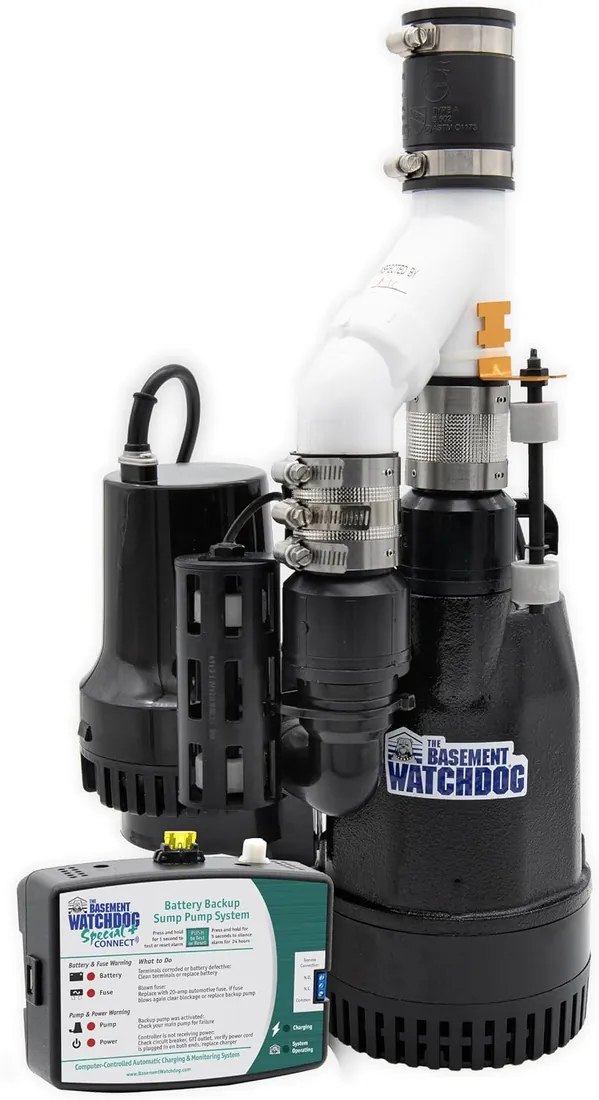
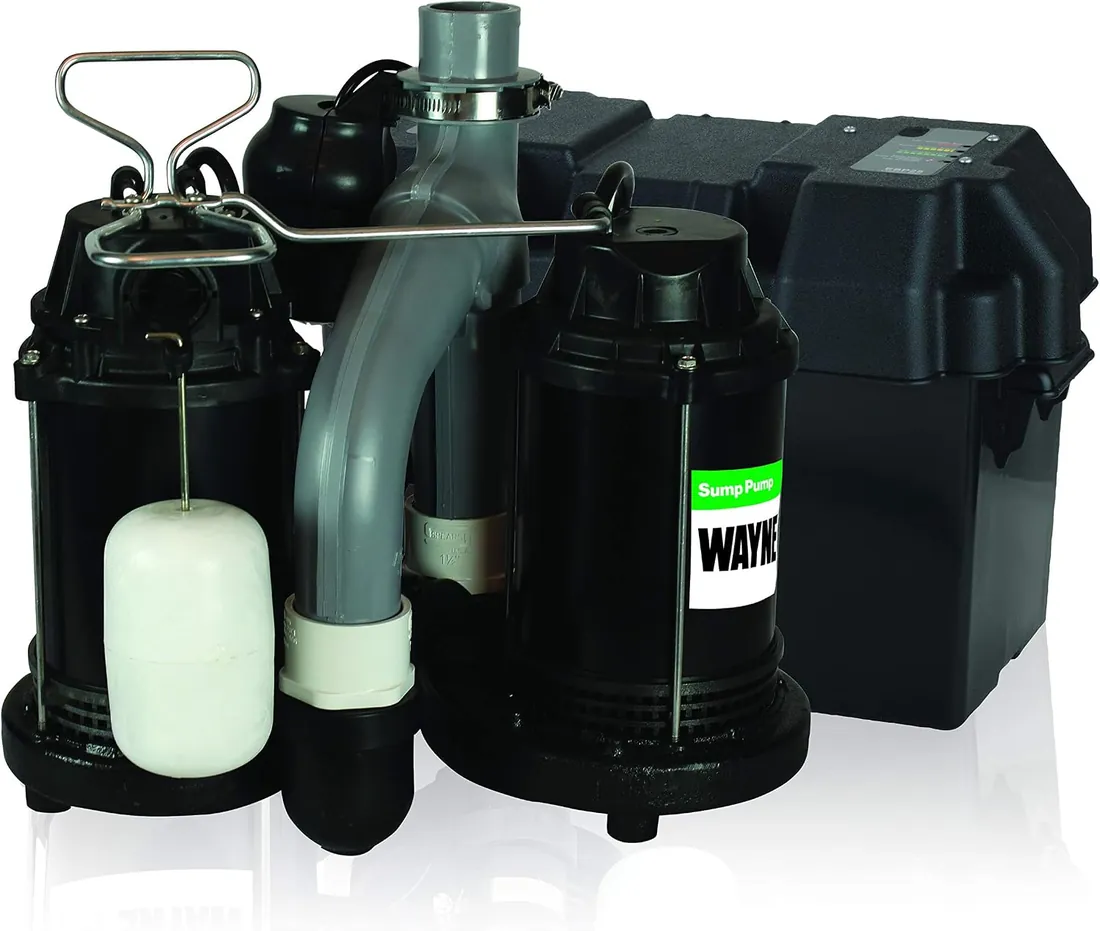
Choose the Basement Watchdog CITS-50 when the pit is under 15 in across, you want twin floats on both pumps, or you plan to wire alerts to a security system or Wi-Fi module.
Choose the Wayne WSS30VN when the basin is 15 in or wider, daily inflow is heavy and you value the longer three-year warranty over extra battery-pump output.
Key specifications
| Specification | Basement Watchdog CITS-50 Combination Primary and Backup Sump Pump | Wayne WSS30VN Primary and Battery Backup Sump Pump System |
|---|---|---|
| Primary pump | 1/2 HP, cast iron housing | 1/2 HP, PSC oil-filled, coated steel housing with cast iron volute |
| Primary flow at 10 ft | 3,540 GPH | 3,840 GPH |
| Primary flow at 15 ft | Not stated in the manual | 3,060 GPH |
| Backup pump | 12 V DC, noncorrosive housing | 12 V DC, 100 W permanent magnet motor |
| Backup flow at 10 ft | 1,850 GPH | 1,500 GPH |
| Primary switch | Caged dual float with plug-in controller; runs 10 s after float drops | Vertical float, on about 9 in, off about 4 in |
| Backup switch | Dual float; pump runs about 25 s after float drops | Float on at 10 to 12 in; 20 to 25 s run-on delay |
| Smallest pit | 12 in wide, 15 in high | 15 in diameter (16 in on the sell sheet), 22 in deep |
| Overall height | 19-1/2 in | 15-1/2 in system height |
| Check valves | Built in on both pumps | Removable check valve, Wayne part 57028-001 |
| Battery | Basement Watchdog AGM standby battery, sold separately | One 75 Ah battery, Wayne WSB1275 recommended, sold separately |
| Remote alerts | Alarm terminal (N.O./N.C.) and USB port for the CONNECT Wi-Fi module | Audible tones and charge lights on the control box |
| Warranty | 2 years, parts and labor (not installation) | 3-year limited |
Figures: Basement Watchdog CITS-50 combination sump pump system instruction manual (US); Wayne WSS30Vn operating instructions and parts manual 670006W-001 I; Wayne WSS30Vn combination sump system sell sheet; Basement Watchdog CITS-50 limited warranty.
Scorecard
| Criterion | Edge | Why |
|---|---|---|
| House-power pumping | Wayne WSS30VN Primary and Battery Backup Sump Pump System | Wayne's primary is rated 3,840 GPH at 10 ft, about 300 GPH more than the Watchdog primary. |
| Battery pump output | Basement Watchdog CITS-50 Combination Primary and Backup Sump Pump | Watchdog rates its backup at 1,850 GPH at 10 ft against 1,500 GPH for the Wayne DC pump. |
| Small or shallow pits | Basement Watchdog CITS-50 Combination Primary and Backup Sump Pump | The CITS-50 fits a pit as small as 12 in wide; Wayne asks for at least 15 in and 22 in of depth. |
| Warranty length | Wayne WSS30VN Primary and Battery Backup Sump Pump System | Wayne covers the system for three years; Glentronics covers the Watchdog for two. |
| Remote alerts | Basement Watchdog CITS-50 Combination Primary and Backup Sump Pump | Only the Watchdog controller has a security-system terminal and a port for a Wi-Fi module. |
The primary pump on house power
Most of the time the backup sits idle, so the AC pump does the real work. Wayne's manual gives the WSS30VN primary 4,500 GPH at 5 ft, 3,840 GPH at 10 ft and 3,060 GPH at 15 ft, from a 1/2 HP oil-filled PSC motor with top suction. Basement Watchdog states a single point for the CITS-50 primary: 3,540 GPH at 10 ft from a 1/2 HP cast iron pump.
That gap of about 300 GPH at 10 ft is modest. A home with a steady, heavy inflow after every storm will notice it as shorter run times; a house with occasional seepage will not. Because Watchdog publishes only one point, you cannot compare the two at higher lifts. Use the sizing calculator to work out your total head.
The battery pump and runtime
On the battery side the order flips. Watchdog rates its backup at 1,850 GPH at 10 ft, while Wayne's 12 V pump makes 1,500 GPH at the same lift, falling to 660 GPH at 15 ft. In a long outage during heavy rain, that extra output from the Watchdog can be the difference between keeping up and slowly losing ground.
Runtime figures are given differently. Watchdog says its own standby battery runs the system for 60 hours at a 10% duty cycle. Wayne says one 75 Ah battery removes up to 10,000 gallons on a single charge. Neither number is a promise for your basement, since inflow sets the real runtime. Our battery backup runtime calculator lets you plug in your own pit and battery.
Both makers also lock the backup out to protect the battery. Wayne blinks a red light and stops the DC pump when the charge falls below a usable level, and Watchdog sounds an alarm that cannot be silenced when little pumping power is left. Treat either warning as a reason to check the battery that day.
Pit size and installation
This is the clearest practical difference. Basement Watchdog says the CITS-50 fits a pit as small as 12 in wide and 15 in high, about the size of a five gallon bucket, and asks you to cut the discharge pipe so it ends 20-1/2 in above the pit floor. Both of its pumps have check valves built in, so the old valve comes out.
Wayne's manual calls for a basin at least 15 in in diameter and 22 in deep, and its sell sheet says 16 in. It requires rigid PVC in 1-1/4 or 1-1/2 in, a removable Wayne check valve just above the basin, and at least 1 in between the float and the basin wall. Many older homes have narrow poured pits, and in those the Wayne simply may not fit.
Switches and redundancy
Watchdog's approach is redundancy. The primary has a caged dual float: water lifts the lower ring to start the pump, and if that fails the upper ring takes over. A blue plug-in controller then runs the pump 10 seconds after the float drops. The backup pump has its own dual float and runs about 25 seconds after the water falls away.
Wayne uses a single non-adjustable vertical float on the AC pump, starting at about 9 in and stopping at about 4 in, plus a separate float for the DC pump that starts at 10 to 12 in. Its controller adds a run-on delay of 20 to 25 seconds to stop short cycling. Both systems are simple to understand, but only the Watchdog protects against a single stuck float on either pump.
Alarms, monitoring and upkeep
Both control boxes beep and show lights for power loss, a weak battery and backup pump activity, and both protect the DC circuit with a 20 A fuse. Wayne sounds a 30 second tone when power fails and a short tone each time the backup starts, with green, yellow and red charge lights.
Watchdog adds a terminal that can feed a home security system, and a USB port for its separately sold CONNECT Wi-Fi module, which sends emails or texts with no subscription. Upkeep schedules differ too: Watchdog suggests maintenance once or twice a year and replacing a battery older than five years, while Wayne asks for inspections three to four times a year and a monthly battery check. More on remote options is in our guide to sump pump alarms and Wi-Fi monitors.
Who each one fits
The Basement Watchdog CITS-50 Combination Primary and Backup Sump Pump fits if
- Your pit is 12 to 14 in across.
- Long power cuts are common where you live.
- You want twin floats on both pumps.
- Alerts should reach your phone or alarm panel.
The Wayne WSS30VN Primary and Battery Backup Sump Pump System fits if
- The basin is at least 15 in wide and 22 in deep.
- Storms bring heavy, steady inflow on house power.
- A three-year warranty matters more than extras.
- You plan to use the recommended Wayne 75 Ah battery.
- You are comfortable plumbing rigid PVC and a new check valve.
Questions readers ask
Is Basement Watchdog or Wayne better for a combo sump system?
It depends on the pit and the risk. The Wayne WSS30VN pumps more on house power and carries a three-year warranty. The Basement Watchdog CITS-50 fits smaller pits, pumps more on the battery and adds twin floats and remote alert options, but its warranty is two years.
Does either system come with a battery?
No. Both are sold without the battery. Watchdog recommends its own maintenance-free AGM standby battery, and Wayne recommends one WSB1275 75 Ah battery. Wayne's battery box takes a 12 V AGM battery up to group 27 size, and Watchdog advises against automotive batteries for standby duty.
Can I add Wi-Fi alerts to either one?
The CITS-50 controller has a USB port for the Basement Watchdog CONNECT Wi-Fi module, sold separately, and a terminal for a security system. Wayne's WSS30VN manual describes audible tones and charge lights only, so remote alerts would need a separate monitor.
Will these systems handle sewage or laundry water?
No. Watchdog limits the CITS-50 to ground water and says not to use it in pits with raw sewage or hazardous liquids. Wayne says the WSS30VN is for clear ground water only and not for laundry discharge, water softener brine, sewage or grey water.
Final verdict
The two systems pull in opposite directions. Wayne's WSS30VN is the stronger everyday pump with the longer warranty, but it needs a full-size basin. Basement Watchdog's CITS-50 squeezes into a small pit, pumps harder on battery and offers redundancy and remote alerts, at the cost of a shorter warranty. Measure the pit first; if it is under 15 in across, the decision is already made.