If a Little Giant VCMA pump will not start, check power, then lift the cover and clean the float, which Little Giant says can become too heavy to rise when coated in debris. If it runs but nothing comes out, clean the check valve and the outlet tubing. If it overflows, make sure it sits level and the inflow is within its rating.
The VCMA models and their letters
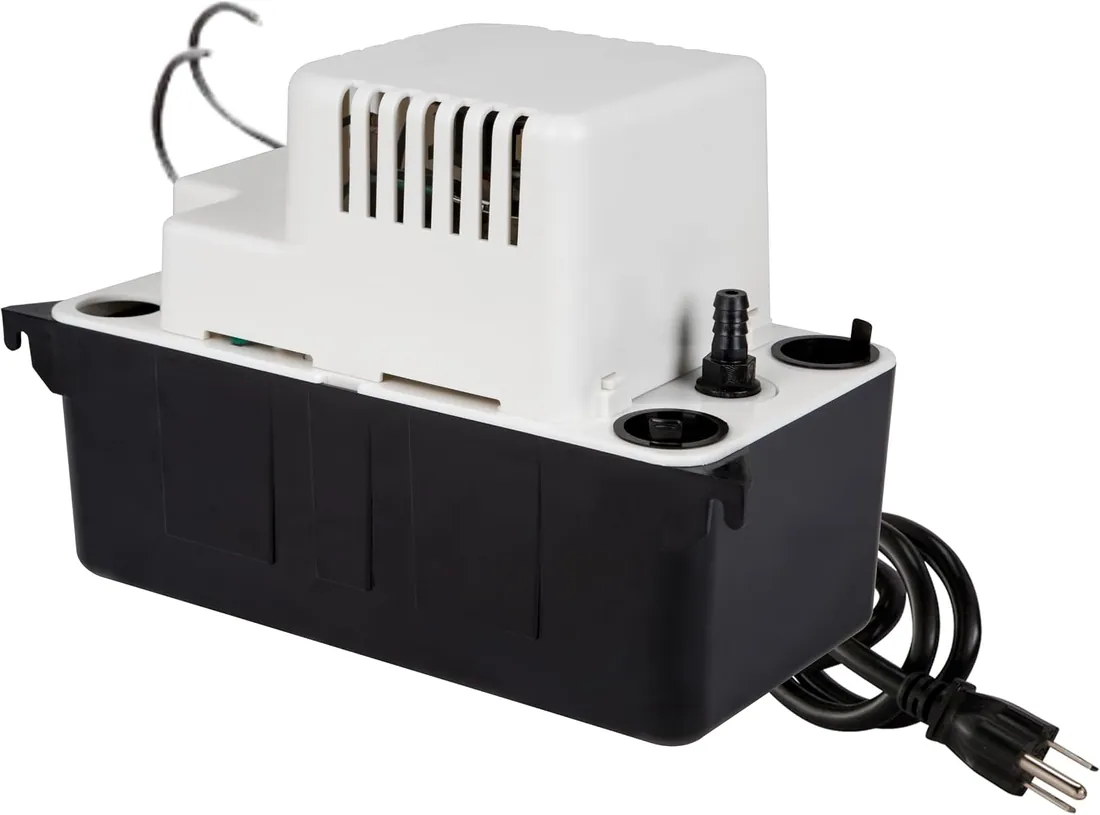
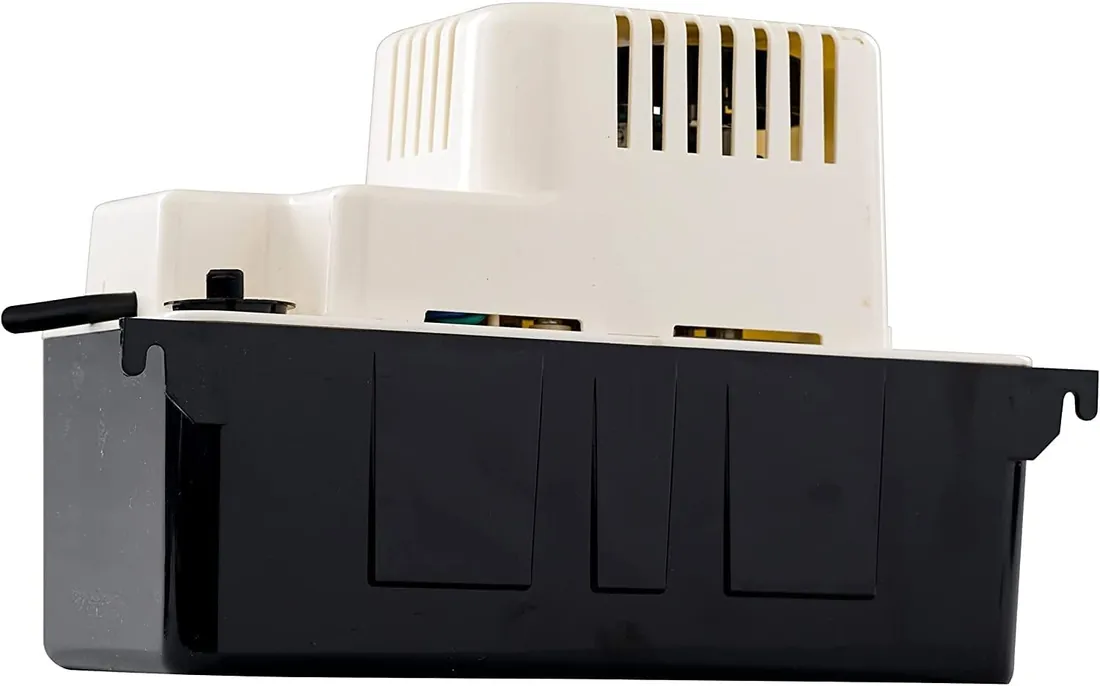
The VCMA family has two sizes and four versions of each. The VCMA-15 has a 1/50 hp motor and the VCMA-20 a 1/30 hp motor; both use a half-gallon tank, a 3/8 in barbed outlet with a built-in check valve and three inlet holes. Little Giant's order tables explain the letters: S means the pump has the safety (overflow) switch, and T means 20 ft of 3/8 in tubing is in the box. So the VCMA-15ULS has the switch, the VCMA-15ULT has tubing, and the ULST has both.
Choose the size by lift. The table shows output at each height through the check valve. Little Giant also asks installers not to route the outlet straight up beyond 75% of the pump's total head capacity.
| Model | Motor | 1 ft | 5 ft | 10 ft | Shut-off |
|---|---|---|---|---|---|
| VCMA-15UL / ULS / ULT / ULST | 1/50 hp, 1 A | 65 | 50 | 25 | 15 ft |
| VCMA-20UL / ULS / ULT / ULST | 1/30 hp, 1.5 A | 80 | 70 | 48 | 20 ft |
Figures: Little Giant VCMA-15 spec sheet 995124; Little Giant VCMA-20 spec sheet 995125.
Pump does not start when the tank is full
Start with power. Little Giant wants the pump on its own dedicated circuit with nothing else on it, and specifically warns against plugging it into a furnace fan outlet or any device that runs intermittently; if the fan is off, so is the pump. Check the breaker and any GFCI.
Next, look at the float. Disconnect power, unsnap the cover and lift it off level. Little Giant's troubleshooting table says a dirty float can be too heavy to operate, and debris in the float path can block it. Clean the float, clear the tank and check that it moves freely. On a brand-new pump, make sure the cardboard insert that locks the switch for shipping was removed; Little Giant warns that leaving it in will cause the pump to overflow.
To test, with the cover off and power on, lift the pump float by hand. The motor should start before the float touches the cover. If it does not, Little Giant's remedy for a defective switch or motor is to replace the pump.
Water overflowing from the tank
Overflow has more causes than a no-start. The manual lists no power, inflow that meets or exceeds the pump's output, a pump that is not level, a dirty float, a stuck or plugged check valve, blocked outlet tubing and an impeller that is not turning. Level matters more than people expect: Little Giant says a pump that is not level may not activate at all.
The inlet setup counts too. Cut the drain pipe from the coil or furnace at a 45 degree angle so it cannot seal against the tank floor, and push it 1 to 3 in into an inlet opening without touching the float. Close unused openings with the supplied caps.
Runs but does not pump, or never shuts off
When the motor runs and nothing comes out, look at the outlet first. The check valve in the barbed adapter can stick or plug with slime; Little Giant suggests removing it and backwashing the discharge port over a sink, then cleaning the valve in warm water and mild soap. Check the tubing for kinks and algae, and confirm the lift is within the pump's rating.
A pump that never stops usually has a float obstruction or a failed switch, or inflow that outpaces it. A pump that cycles constantly most often has a leaking check valve letting water run back into the tank. Little Giant also notes that its outlet tubing should be no larger than 3/8 in inside diameter, to limit how much water falls back.
- Unplug the pump and lift off the cover, keeping it level.
- Clean the floats and the tank with warm water and mild soap.
- Remove the check valve and backwash the discharge port.
- Flush outlet tubing and remove any kinks.
- Refit, restore power and lift the float to confirm it starts.
Wiring the safety (high water) switch
On S models, a second float operates a high water switch with two black low-voltage leads. Little Giant ships it wired to the normally open terminal, which breaks the thermostat circuit on high water and stops the air conditioner or furnace from making more condensate. The leads go in series with the thermostat circuit as the equipment manual specifies.
Alternatively, the lead can be moved to the normally closed terminal to switch on an external alarm or relay. The manual warns that the switch is mounted so its normal function is reversed, so follow the terminal labels rather than habit, and keep it on a Class II low-voltage circuit, never line voltage. Test it by lifting the high water float: the air handler should stop, or the alarm should sound, before the float touches the cover.
Maintenance and the furnace acid warning
Little Giant asks for an inspection and test every six months, more often in heavy use. On high-efficiency furnaces it adds a specific warning: flush the tank with fresh water routinely so acidic condensate cannot form pockets that pit the parts. Before installing on a new air conditioner, let the system cycle a few times into a bucket to flush residual oils. The pump carries a 12-month warranty. If you need a new one, compare the VCMA-15ULS and VCMA-20ULS, or see the furnace and AC condensate pump list.
Common mistakes
- Plugging the pump into the furnace fan outlet instead of a dedicated circuit.
- Leaving the shipping cardboard insert in a new pump.
- Mounting the pump off level so the float never rises properly.
- Using outlet tubing wider than 3/8 in inside diameter.
- Wiring the safety switch to line voltage instead of the thermostat circuit.
- Never flushing the tank on a condensing furnace.
Products that fit
Questions readers ask
Does a Little Giant condensate pump have a reset button?
Little Giant's VCMA manual describes no reset button. The motor is thermally protected, and the safety switch resets itself when the water level drops. If the pump stays off, check power, the float and the check valve.
Why does my Little Giant condensate pump keep running?
The manual lists a blocked float path, a failed switch and inflow that exceeds the pump's output. If it cycles on and off constantly, the check valve is likely leaking water back into the tank.
How do I clean a Little Giant condensate pump?
Unplug it, lift off the cover, clean the floats and tank with warm water and mild soap, backwash the discharge port and clean the check valve. Flush the tank with fresh water, refit the cover and test it.