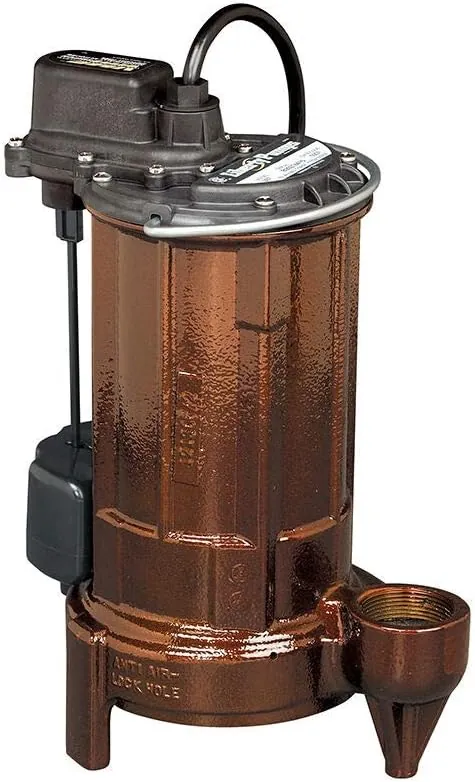
Choose the Liberty 287 when the discharge climbs very high, the pit is as narrow as 10 in, or debris calls for a 3/4 in solids passage behind a bottom screen.
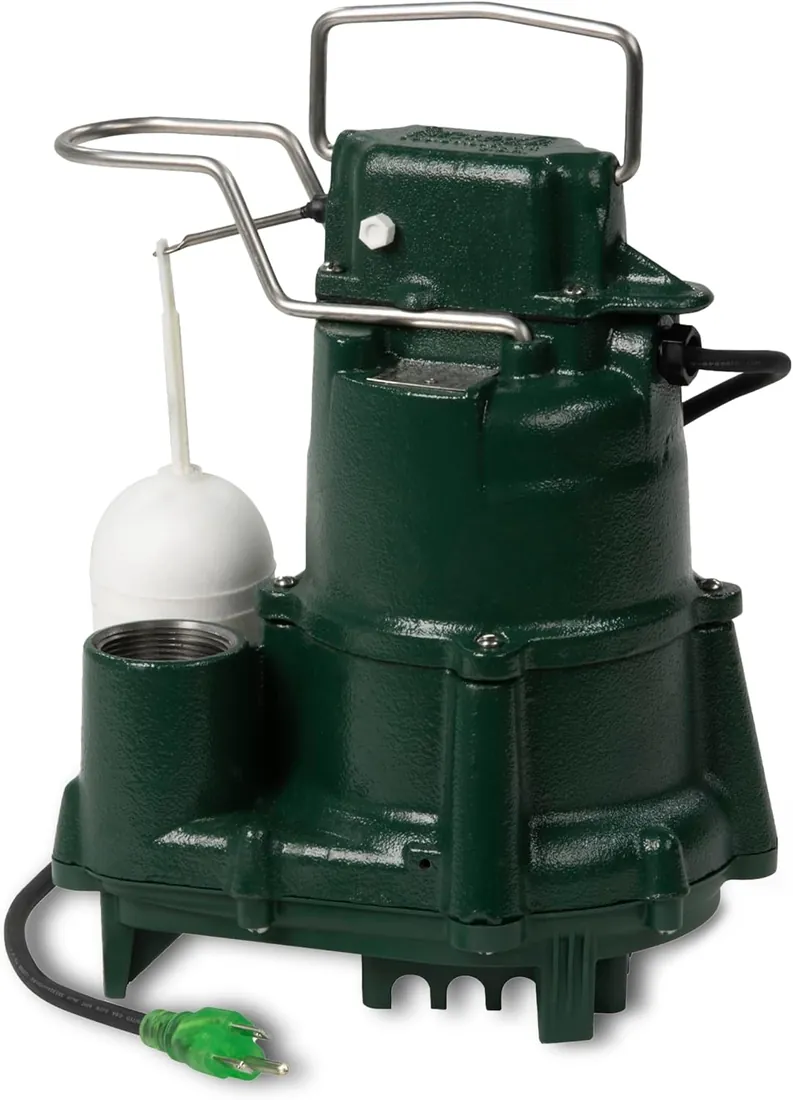
Choose the Zoeller M98 when you want flow at each lift in writing, a lower start-to-stop band, an LED power check and the wider spread of Zoeller versions.
Key specifications
| Specification | Liberty Pumps 287 Sump Pump | Zoeller M98 Flow-Mate Sump Pump |
|---|---|---|
| Horsepower | 1/2 hp | 1/2 HP |
| Motor | Split capacitor, 3450 RPM | Split capacitor, 1725 RPM |
| Running amps at 115 V | 8.0 A | 9.4 A |
| Max flow | Flow rates to 68 GPM (280-Series brochure) | 72 GPM |
| Flow at 10 ft | Curve published as a graphic only | 61 GPM |
| Flow at 20 ft | Curve published as a graphic only | 25 GPM |
| Max head | Heads to 37 ft (280-Series brochure) | 23 ft |
| Switch | Vertical magnetic float, on 9.5 in, off 4 in | Integral float, on 9-1/2 in, off 3 in |
| Solids passed | 3/4 in | 1/2 in |
| Bearings | Upper and lower ball bearings | Oil-fed cast iron bearings |
| Height | 13 in | 12-1/16 in |
| Weight | 29 lb | 36 lb |
| Cord | 10 ft (25 ft as 287-2) | 9 ft automatic |
| Warranty | 3-year limited | 3-year limited |
Figures: Liberty Pumps 280-Series engineering specification R04/2025; Zoeller technical data sheet FM2779, Flow-Mate Model 98; Liberty Pumps 280-Series sales literature LLIT002000; Liberty Pumps sump pump brochure; Liberty Pumps installation manual 7035000R (250, 280 and 290 series); Zoeller Model 98 product page.
Scorecard
| Criterion | Edge | Why |
|---|---|---|
| Highest lift | Liberty Pumps 287 Sump Pump | Liberty gives the 280-Series heads to 37 ft; Zoeller lists shut-off at 23 ft for the M98. |
| Published flow at each lift | Zoeller M98 Flow-Mate Sump Pump | Zoeller prints 72, 61, 45 and 25 GPM at four heights; Liberty's curve is an image only. |
| Debris handling | Liberty Pumps 287 Sump Pump | The 287 passes 3/4 in solids and has a removable stainless bottom screen. |
| Running current | Liberty Pumps 287 Sump Pump | The 287 draws 8.0 A at 115 V against 9.4 A for the M98. |
| Weight to lift | Liberty Pumps 287 Sump Pump | Liberty lists the 287 at 29 lb; the automatic M98 weighs 36 lb on Zoeller's chart. |
| Power check at a glance | Zoeller M98 Flow-Mate Sump Pump | The M98 ships with Zoeller's LED plug, which lights whenever the outlet is live. |
Which models stand for each brand
Most people who type Liberty against Zoeller are choosing a basement sump pump, so this page compares the two brands' automatic 1/2 HP cast iron models, the size people usually step up to when a 1/3 HP pump is not enough. For Liberty that is the 287, its heavy-duty magnetic-float pump in the 280-Series. For Zoeller it is the M98 Flow-Mate, the brand's best-known half-horsepower pump.
Both brands also build sewage ejectors and grinder pumps, and those questions are different enough to need their own comparison. For the smaller 1/3 HP class, see the Zoeller M53 against the Liberty 257.
High lift against documented flow
On paper, the Liberty pushes much higher. Its brochure gives the 280-Series heads to 37 ft, while Zoeller lists the M98's shut-off at 23 ft. If your discharge climbs from a deep pit up through a finished first floor, or exits far up a slope, the 287 is the pump with headroom.
For most basements, though, the lift is far lower, and here Zoeller gives you more to work with. Its table shows 72 GPM at 5 ft, 61 GPM at 10 ft, 45 GPM at 15 ft and 25 GPM at 20 ft. Liberty's curve is a graphic, so we cannot say how the 287 compares at 10 ft without reading an image, which we do not do. Its brochure figure of flow to 68 GPM suggests the two pumps sit close together at low lift. The sizing calculator finds your total head.
Two takes on a 1/2 HP motor
Both makers use a permanent split capacitor motor sealed in oil with thermal overload protection, but they build it differently. Liberty spins the 287 at 3450 RPM on upper and lower ball bearings with a carbon and ceramic shaft seal, drawing 8.0 A at 115 V. Zoeller runs the M98 at 1725 RPM on oil-fed cast iron bearings, drawing 9.4 A.
The slower Zoeller motor and heavier castings explain much of its 36 lb weight, against 29 lb for the Liberty. A slow-turning motor tends to run quietly and wear its bearings gently, while the faster Liberty motor helps it reach its higher head from a compact body.
Float design and pit width
Each pump starts at about 9-1/2 in. The Zoeller stops at about 3 in and the Liberty at 4 in, so the M98 empties a slightly deeper slice of water each cycle. The Liberty uses a vertical magnetic float with no switch arm passing through a seal; the Zoeller uses an integral float-operated mechanical switch in a guard on the pump.
Liberty approves its magnetic-float models for a pit as small as 10 in across. Zoeller does not print a minimum for the automatic M98, but asks for 18 in or more when a variable-level float is used, as on its BN98 and BE98 versions. In a tight pit, the Liberty is the safer fit.
Neither switch can be adjusted on these automatic models. If you need a wider pumping band to cut the number of starts in a large basin, both brands sell versions with a tethered or piggyback float instead, and that is often the better route than relying on the factory levels of either pump here.
Solids, screens and housings
The 287's vortex impeller passes 3/4 in solids, and a removable stainless steel screen guards its bottom intake. The M98 passes 1/2 in solids through its non-clogging vortex impeller and can sit on Zoeller's optional stand, which lifts the intake 2 in off the floor.
Both bodies are cast iron with a powder coat. Liberty casts the 287 housing as one piece in class 25 iron, removing a seal ring. Zoeller casts the M98 cap, motor housing and pump housing in iron and lists a thermoplastic or cast iron base and impeller depending on version. Each uses stainless hardware.
Cords, versions and warranty
The 287 comes with a 10 ft quick-connect cord, replaceable without opening the motor, or 25 ft as the 287-2, and a 208-230 V 287HV version. The M98 has a 9 ft cord on the automatic model and a broader family: nonautomatic N98 and E98, 230 V D98 and piggyback-float BN98 and BE98 builds.
Both carry three-year limited warranties that need proof of purchase. Zoeller recommends a vent hole of about 3/16 in below the check valve and a full system check at least every three months; Liberty builds an anti-airlock hole into the volute and suggests an extra hole of no more than 1/8 in if air lock occurs.
Who each one fits
The Liberty Pumps 287 Sump Pump fits if
- The discharge climbs well beyond 20 ft from the pit floor to the outlet.
- The pit is narrow, down to 10 in across, with little room for a float.
- Gravel or concrete chips reach the pump and need a 3/4 in passage.
- You want lower running current and a lighter pump to handle.
The Zoeller M98 Flow-Mate Sump Pump fits if
- You want flow at each lift printed by the maker before choosing.
- The lift stays under about 20 ft, where the M98 curve is documented.
- You may need a nonautomatic, 230 V or piggyback version later.
- You like seeing power at the outlet from the lit LED plug.
Questions readers ask
Is Liberty or Zoeller the better sump pump brand?
Both are long-established makers with three-year warranties on these models. At 1/2 HP, Liberty's 287 claims more head and passes larger solids, while Zoeller's M98 publishes its full curve and offers more versions. The better buy depends on your lift, pit width and debris.
Which pumps more water, the Liberty 287 or the Zoeller M98?
Zoeller documents 72 GPM at 5 ft and 61 GPM at 10 ft for the M98. Liberty's brochure gives the 280-Series flow to 68 GPM but shows the curve only as an image. At low lift they look close; at high lift Liberty's 37 ft rating leads.
Can a Liberty 287 replace a Zoeller M98 without new plumbing?
Usually. Both use a 1-1/2 in discharge and start near 9-1/2 in, so the pipe, check valve and inlet height normally suit either pump. The 287 is slightly taller at 13 in, so confirm the lid clears the float rod.
What about Liberty and Zoeller sewage pumps?
This page covers basement sump pumps only. Sewage ejectors and grinder pumps handle raw waste and larger solids, so compare them on the sewage ejector pump pages rather than against these models.
Final verdict
At half a horsepower these brands split cleanly. The Liberty 287 suits tall discharges, narrow pits and gritty water, with lower current and less weight. The Zoeller M98 suits buyers who want the curve in writing, an LED power check and the broadest range of versions, at the cost of a heavier pump with a lower maximum head.