Set the pump level and below the equipment drain, run the drain line a short way into the tank inlet, and take the outlet tubing straight up before sloping it down to a drain. Remove any shipping insert from the float, give the pump its own outlet, and wire the high-level switch to stop the furnace, air handler or mini split if the water rises. Then pour in water.
Pick the spot: level and below the drain
Water reaches the pump by gravity, so the pump inlet must sit below the coil or furnace drain. Little Giant's VCMA manual asks for a flat, level surface strong enough for the pump and a full tank, or wall mounting through the slots at each end. A pump that is not level may not switch on, which Little Giant lists among the causes of an overflowing tank.
Keep the motor's air vents clear and avoid places where the pump will be splashed. For a mini split, a compact pump can sit in the line set cover or a ceiling void near the head; place its sensor where the condensate reaches it first and mount the pump where its sound will not carry into the room.
Connect the drain lines to the inlet
The VCMA tank accepts up to three drain lines, which is useful when a furnace and an air conditioner coil share one pump. Little Giant asks for each pipe end to be cut at 45 degrees so it cannot seal against the tank floor, and for the pipes to enter the inlet openings 1 to 3 in without touching the float. Cap any unused openings with the supplied plugs.
Check the total inflow against the pump's rating. If inflow matches or exceeds what the pump can move, the tank will overflow however carefully it is installed, and Little Giant's remedy is a larger pump. Before connecting a new air conditioner, Little Giant also suggests letting it cycle several times into a separate container to flush out residual oil that can damage the pump.
- Cut each drain pipe end at a 45 degree angle.
- Insert the pipes 1 to 3 in into the inlet openings.
- Make sure no pipe can touch or block the float.
- Cap any inlet openings you are not using.
Route the outlet tubing
Clamp the outlet tubing to the pump's check valve. Little Giant specifies 3/8 in inside diameter tubing at most, so that too much water does not drain back into the tank between cycles. Run the tubing straight up first, and keep the total lift below 75 percent of the pump's rated head; the VCMA-15 shuts off at 15 ft and the VCMA-20 at 20 ft on 115 V.
At the top, slope the line down slightly toward the drain and end it at or below the level of the pump if possible. Little Giant explains that this creates a siphon that helps the pump. If you cannot slope it down, form an inverted U at the highest point directly above the pump. Avoid kinks; a kinked line is one of the commonest reasons Little Giant gives for a pump that runs but does not discharge.
| Model | Volts | Amps | Shut-off head |
|---|---|---|---|
| VCMA-15 | 115 | 1.0 | 15 ft |
| VCMA-20 | 115 | 1.5 | 20 ft |
| VCMA-20 | 230 | 0.5 | 17 ft |
Figures: Little Giant VCMA condensate pump owner's manual 998086.
Power and the high-level safety switch
Plug the pump into a constant power source that matches its nameplate, on a circuit with no other equipment. Little Giant warns against connecting it to a fan or anything that runs intermittently, and asks for a GFCI where code requires one. Some models come with stripped leads that must be connected in a junction box.
The safety switch is the part that prevents water damage. On the VCMA it is factory wired to open a low-voltage circuit, so it can sit in series with the thermostat circuit and stop the cooling or heating equipment when the tank is full. It can be moved to the other terminal to close a circuit for an external alarm instead. Many mini split pumps work the same way; Aquastrong's CDS036 listing uses one pair of terminals for the appliance and another for an alarm. Follow the equipment maker's wiring diagram, and call an HVAC technician if it is unclear.
Remove the shipping insert and run it
Little Giant packs a cardboard insert to stop the switch moving in transit and states that leaving it in place will make the pump overflow. Take it out before the first run. Then pour water into the tank: the motor should start before the float reaches the cover, and the high-level switch should trip before its float does, stopping the equipment or sounding the alarm.
Inspect and test the system every six months, as Little Giant asks, cleaning the floats and check valve and flushing the tank so acidic furnace condensate does not pit it. To compare pumps for your setup, see the furnace and AC condensate pump list or the Little Giant VCMA-15ULS page.
Common mistakes
- Leaving the cardboard shipping insert under the float.
- Plugging the pump into an outlet switched with a fan or light.
- Using oversized outlet tubing that drains back into the tank.
- Leaving the high-level safety switch unconnected to the equipment.
- Mounting the pump above the drain it is meant to serve.
Products that fit
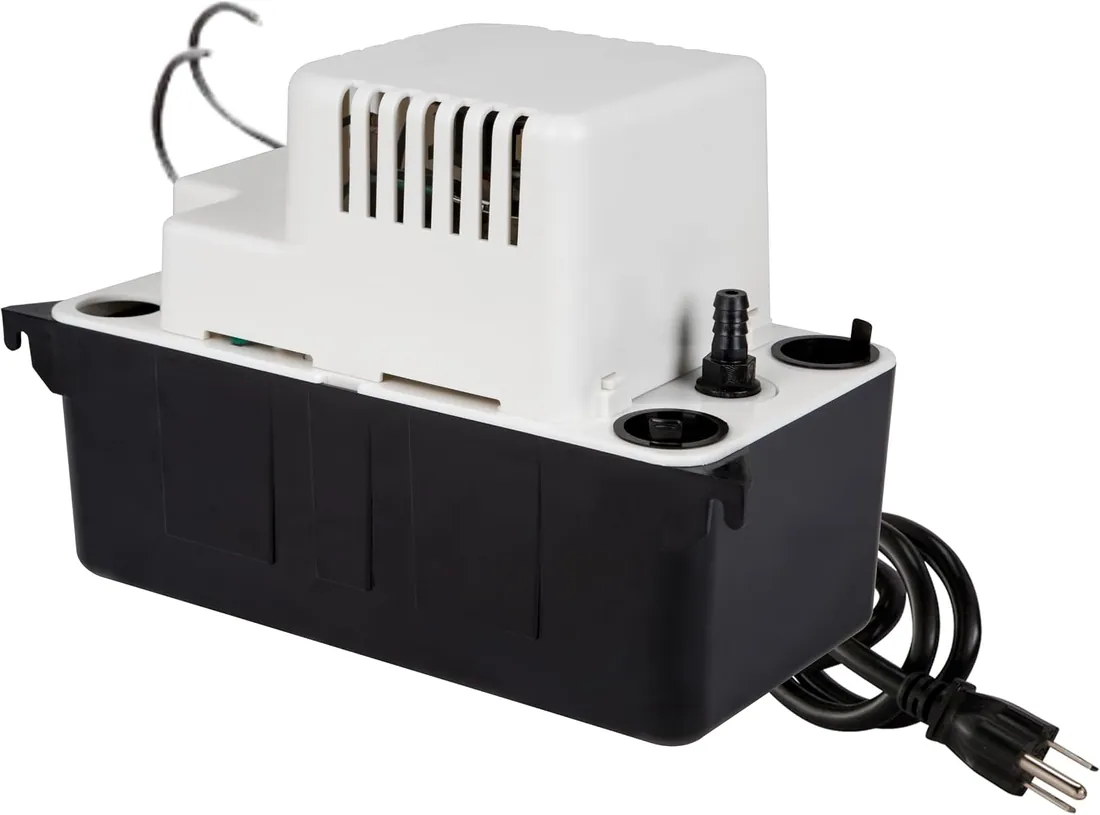
Little Giant VCMA-15ULS Condensate Pump
Tank-style pump with a safety switch, rated to 15 ft shut-off head on 115 V.
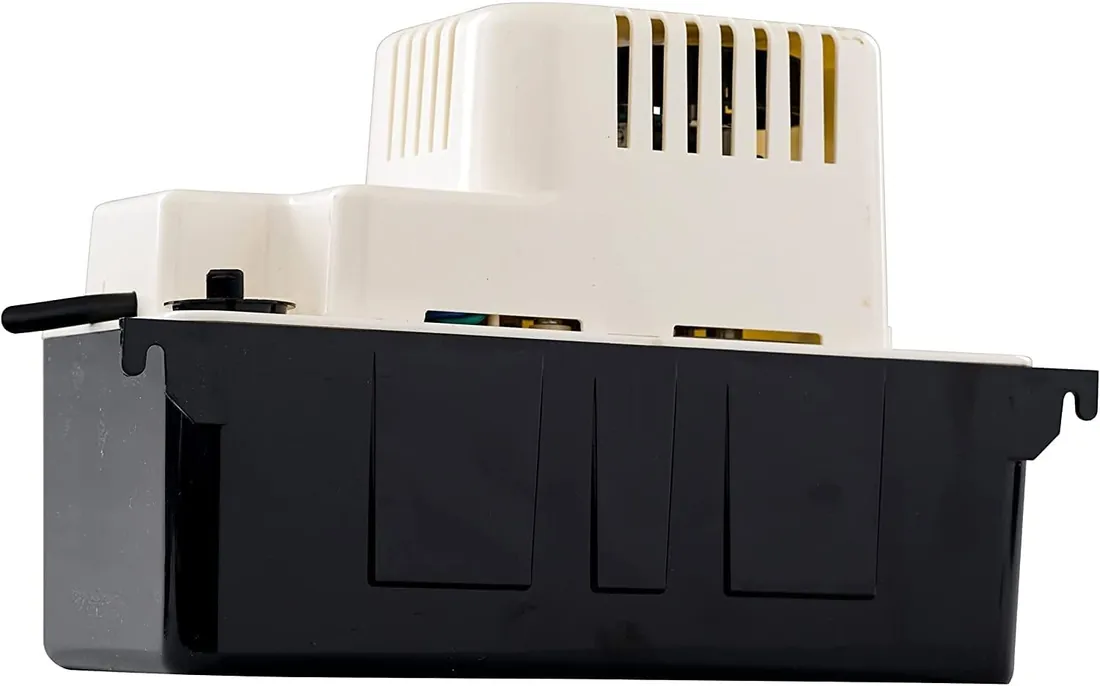
Little Giant VCMA-20ULS Condensate Pump
Higher-lift VCMA model for longer routes, at 20 ft shut-off on 115 V.
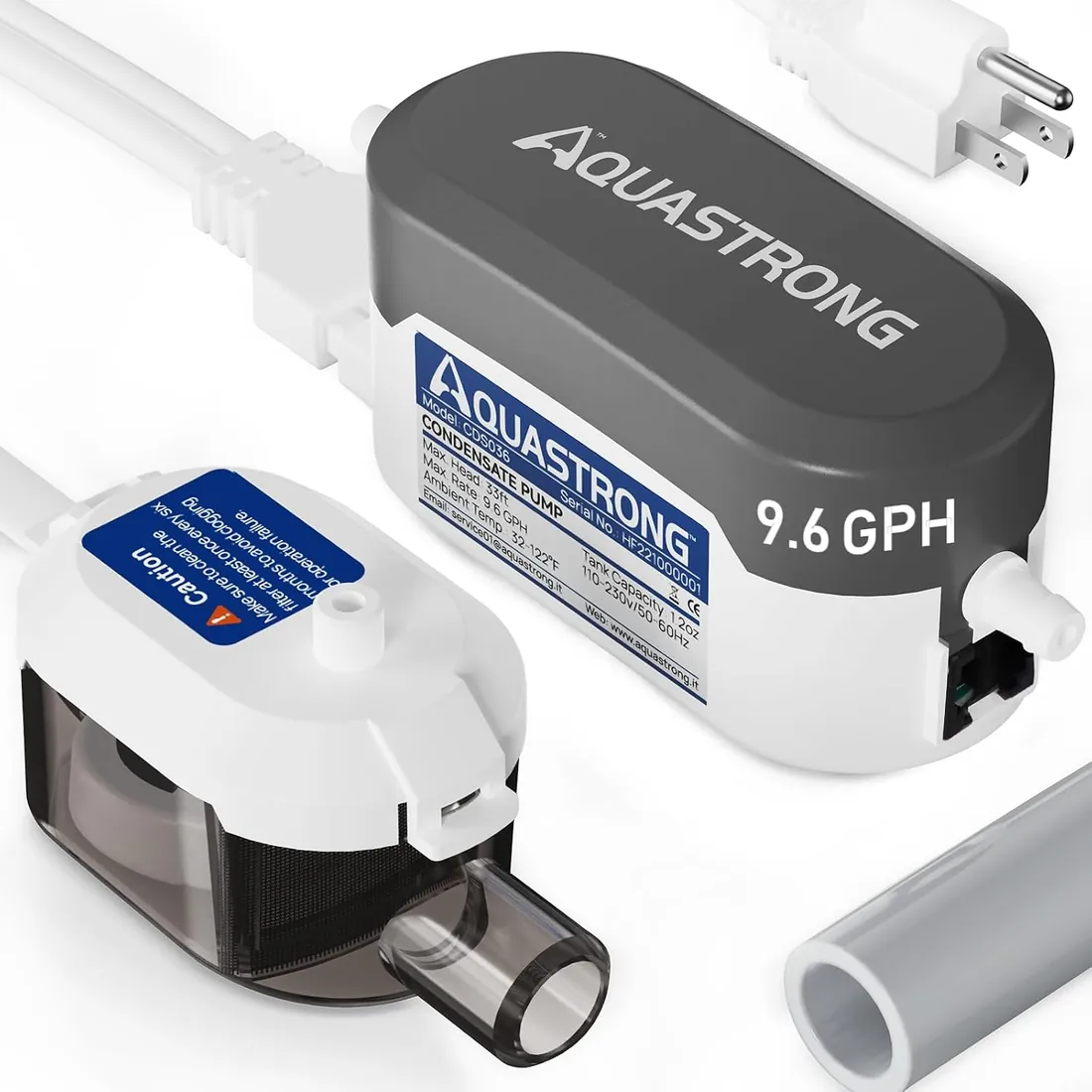
Aquastrong CDS036 Mini Split Condensate Pump
Compact mini split pump with separate appliance and alarm switch terminals.
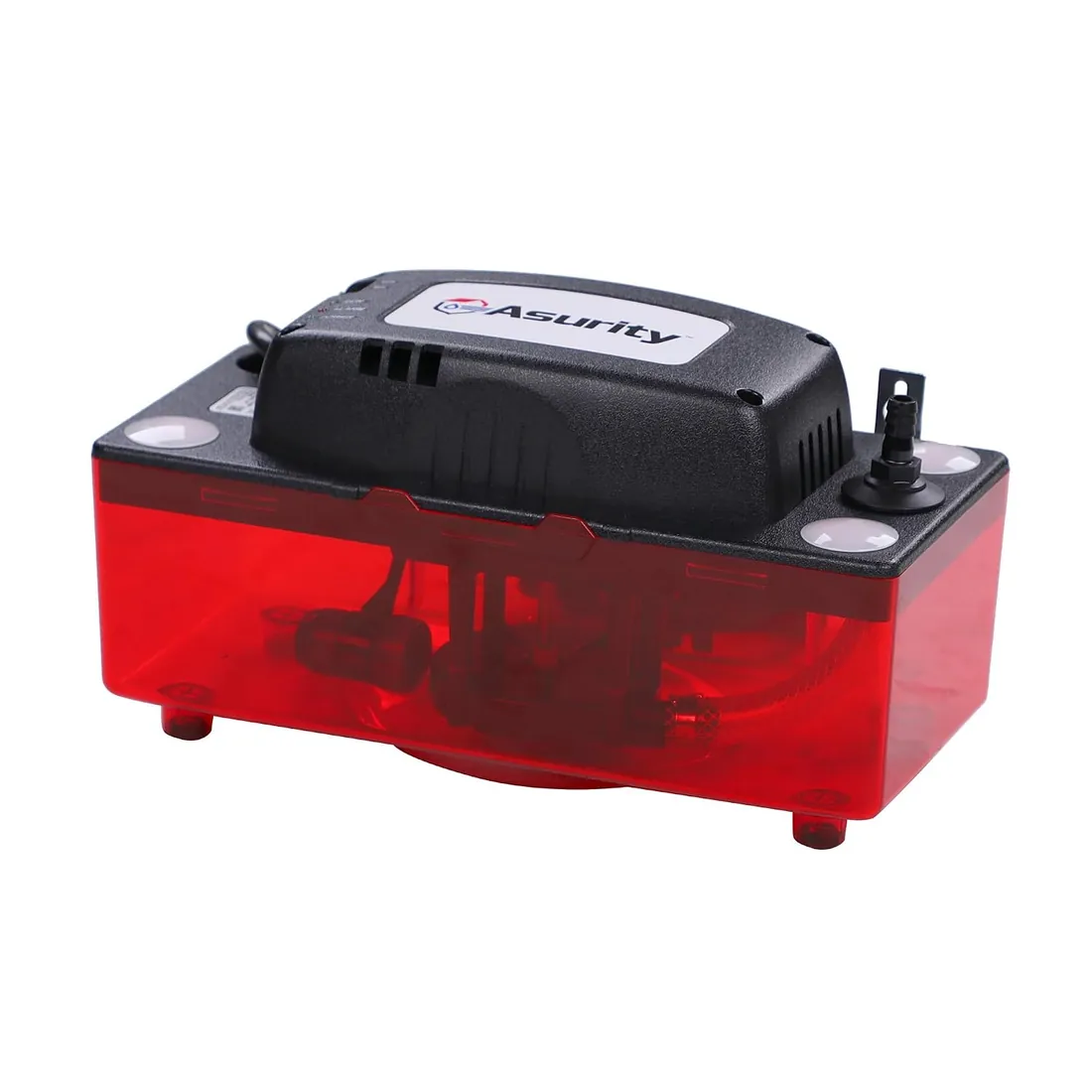
Diversitech ULTRACP-22 Condensate Pump
Compact HVAC tank pump for furnaces, air conditioners and dehumidifiers.
Questions readers ask
Where should a condensate pump be installed?
Level, close to the equipment and below its drain outlet so condensate flows into the tank by gravity. Keep the vents clear and the pump away from splashing. A mini split pump can be hidden in a cover or ceiling void near the head.
How high can a condensate pump lift water?
Each model has a shut-off head, such as 15 ft for the VCMA-15. Little Giant asks installers to keep the route below 75 percent of that figure so the pump still moves water at a useful rate.
Should the condensate pump safety switch be wired?
Yes. Wired in series with the thermostat circuit, it stops the equipment making condensate when the pump fails, which prevents overflow. It can instead trigger an alarm. Follow the equipment's wiring diagram.
Can I plug a condensate pump into the furnace outlet?
Only if that outlet has constant power. Little Giant says the pump needs its own circuit with no other equipment and must not be connected to a fan or anything that runs intermittently.