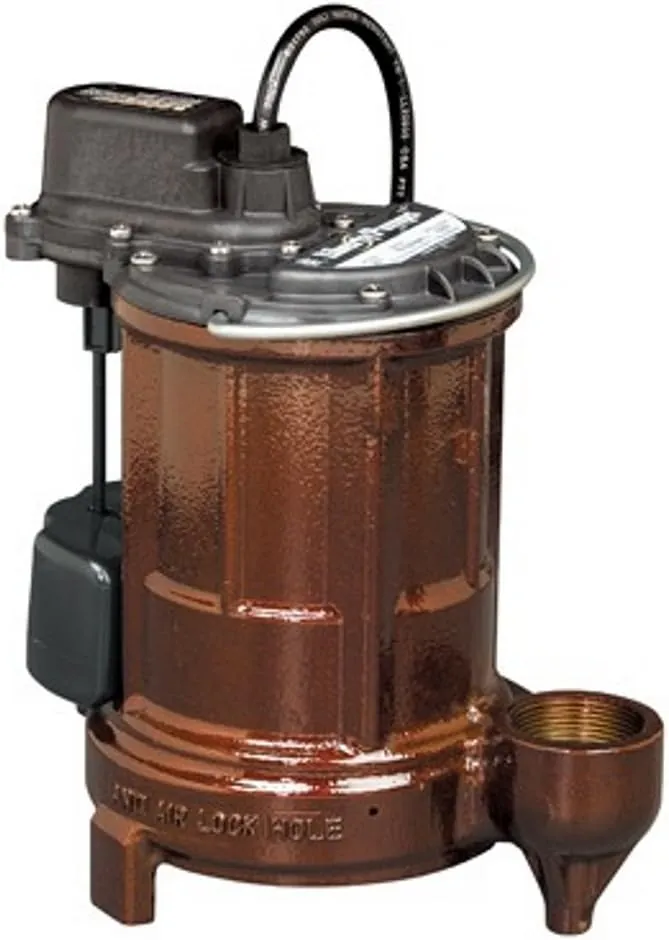
Choose the Liberty 257 when running current matters, small solids may reach the pump, or you want a cord that can be swapped without replacing the whole pump.
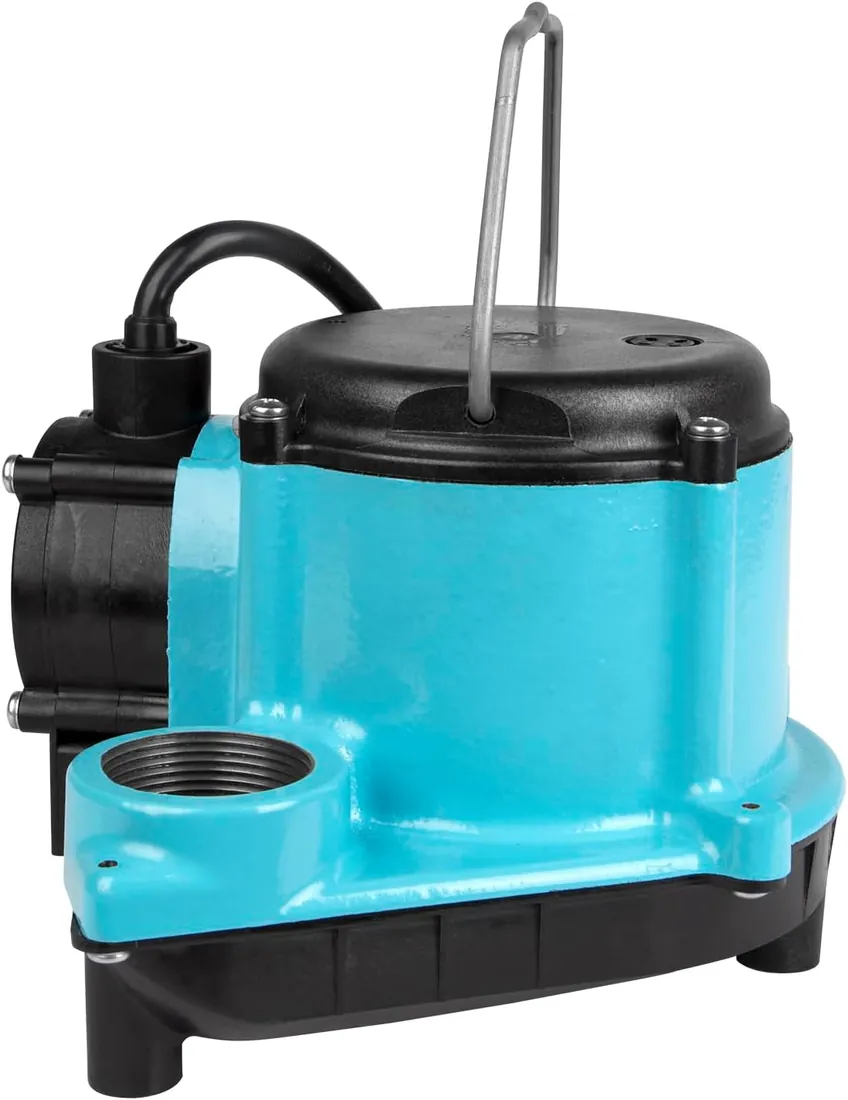
Choose the Little Giant 6-CIA when the outlet is far away, you want a switch with no moving float, and you value a printed flow table for short lifts.
Key specifications
| Specification | Liberty Pumps 257 Sump Pump | Little Giant 6-CIA Sump Pump (506125) |
|---|---|---|
| Horsepower | 1/3 hp | 1/3 HP |
| Motor | Split capacitor, 3450 RPM | Shaded pole |
| Running amps at 115 V | 5.2 A | 9.0 A |
| Starting amps | 8 A locked rotor | 14.3 A |
| Flow at 10 ft | Curve published as a graphic only | 29 GPM |
| Max flow and head | 50 gpm, 21 ft (retail listing figures) | 46 GPM at 5 ft, shut-off 18 ft |
| Switch | Vertical magnetic float, on 7 in, off 4 in | Integral diaphragm, on 7-10 in, off 1-4 in |
| Smallest basin | 10 in diameter | 10 in diameter |
| Solids | 1/2 in | Clear water only |
| Housing | One-piece class 25 cast iron | Epoxy-coated cast iron |
| Cord | 10 ft quick-connect, replaceable | 25 ft, not replaceable |
| Weight | 21 lb | 17.5 lb |
| Max liquid temperature | 140°F intermittent | 140°F |
| Warranty | 3-year limited | 3-year limited |
Figures: Liberty Pumps 250-Series engineering specification 250_P1 R04/2025; Little Giant Model 6 Series sump pump owner's manual 993865; Liberty Pumps 250-Series sales literature LLIT002500; Amazon listing for Little Giant 6-CIA (506125); Amazon listing for Liberty Pumps 257; Liberty Pumps installation manual 7035000R (250, 280 and 290 series).
Scorecard
| Criterion | Edge | Why |
|---|---|---|
| Running current | Liberty Pumps 257 Sump Pump | The Liberty draws 5.2 A running against 9.0 A for the Little Giant, and far less at start. |
| Published flow table | Little Giant 6-CIA Sump Pump (506125) | Little Giant prints flow at 5, 10 and 15 ft; Liberty's curve exists only as a chart image. |
| Dirtier water | Liberty Pumps 257 Sump Pump | The 257 passes 1/2 in solids; Little Giant limits the 6-CIA to clear water. |
| Cord reach | Little Giant 6-CIA Sump Pump (506125) | A 25 ft cord on the 6-CIA against 10 ft on the 257, though the Liberty cord can be replaced. |
| Tight pits | Even | Each maker approves its pump for a basin as small as 10 in across. |
Which models stand for each brand
The search behind this page asks about the brands, not models, so we compare each one's well-known 1/3 HP cast iron pump for small pits. Liberty calls the 257 its best-selling sump pump. Little Giant's 6-CIA is the automatic pump in its 6 Series, with a built-in diaphragm switch; the version here has a 25 ft cord.
Both are plug-in automatic pumps that their makers allow in a basin as narrow as 10 in, which is why they often end up on the same shortlist when an old pump in a small liner needs replacing.
A frugal motor against a simple one
Liberty runs the 257 on a permanent split capacitor motor at 3450 RPM, drawing 5.2 A and 8 A locked rotor. Little Giant's listing gives the 6-CIA a shaded pole motor drawing 9.0 A running and 14.3 A at start, about 720 W.
In daily use both run happily on an ordinary household circuit, and Little Giant asks for the pump to have a circuit of its own. The difference shows up on backup power: a small inverter or a portable generator carries the Liberty's start-up surge much more easily. A shaded pole motor has no capacitor to fail, which is part of why such designs have stayed in production for so long, but it uses noticeably more power for the same horsepower.
What each maker publishes on flow
Little Giant's manual gives the 6-CIA 46 GPM at 5 ft, 29 GPM at 10 ft and 12.5 GPM at 15 ft, with shut-off at 18 ft. That is a steep curve, strongest at short lifts.
Liberty draws the 250-Series curve only as a graphic, and we do not read numbers off images. The retail listing gives 50 gpm and 21 ft as maximums for the 257, which suggests a flatter curve with a higher ceiling, but that comes from a seller page rather than the maker. For a pipe climbing more than about 12 ft, put the Little Giant's 12.5 GPM at 15 ft next to your inflow before choosing it. The sizing calculator gives you your head.
Magnetic float against diaphragm
Liberty's vertical magnetic float slides on a short rod beside the motor and works the switch with a magnet, so no switch arm passes through a rubber boot. The current manual sets it at 7 in on and 4 in off, fixed at the factory.
The 6-CIA has no float. A diaphragm inside the switch housing senses the water pressure as the pit fills, turning the pump on between 7 and 10 in and off between 1 and 4 in. A breather tube runs inside the cord to the plug, so the cord must lie without kinks. Neither switch can snag on a pipe, though the diaphragm has nothing visible to watch when you test it.
Solids and pit conditions
Liberty rates the 257's vortex impeller for 1/2 in solids. Little Giant restricts the 6 Series to clear water and warns against sand, gravel, floating debris and effluent, and says the pump should never sit on soil, clay or gravel.
In a lined plastic basin with clean groundwater, both work well. In a pit fed by old clay tile, or one with a sandy floor, the Liberty is the safer pick, preferably on a stand to lift the intake off the bottom. Our basin size guide explains how pit width changes cycle length for both.
Cords, weight and warranty
The 6-CIA's 25 ft cord can reach an outlet across the room without an extension, which Little Giant forbids. The catch is that the cord cannot be replaced; damage means a new pump. The 257's 10 ft quick-connect cord can be swapped in seconds without breaking the motor seal, and a 25 ft version is sold as the 257-2.
The Little Giant is lighter at 17.5 lb against 21 lb. Both makers give three years of limited cover, and both ask for a relief or anti-airlock hole in the discharge so trapped air does not stop the pump from priming.
Little Giant adds a habit worth keeping with any pump: every time it runs, look for the small stream of water from the relief hole. If it stops, the hole has clogged and should be cleared before the next storm. Liberty makes the same point about its anti-airlock hole in the volute. A pump that hums but moves no water after a long dry spell is usually air-locked rather than broken, and a clear hole is the cure.
Who each one fits
The Liberty Pumps 257 Sump Pump fits if
- The pump will lean on a portable generator or a small inverter during outages.
- Grit or small stones occasionally wash into the pit from an older drain line.
- You want a cord that can be replaced without buying a new pump.
- You like a switch you can see move when you test it.
The Little Giant 6-CIA Sump Pump (506125) fits if
- The nearest outlet is well beyond 10 ft from the pit.
- The lift is short and you want the maker's flow numbers in writing.
- You prefer a switch with no float at all to catch on anything.
- The pit is a clean plastic liner holding clear groundwater.
Questions readers ask
Is Liberty Pumps or Little Giant the better brand?
Both make dependable small cast iron pumps with three-year warranties. Liberty's 257 uses less current and handles small solids; Little Giant's 6-CIA has a float-free diaphragm switch, a long cord and a published flow table. Choose on pit conditions and power.
Which one moves more water?
Little Giant publishes 29 GPM at 10 ft and an 18 ft shut-off for the 6-CIA. Liberty shows its curve only as an image; the retail listing gives the 257 a 50 gpm maximum and 21 ft ceiling. On available numbers, the 257 appears stronger at higher lifts.
Will both fit a small 10 in basin?
Yes. Liberty approves its magnetic-float models for a 10 in basin and Little Giant says its diaphragm switch models can be used in one. Both makers still prefer a wider pit, which gives longer cycles and less switch wear.
Can I use an extension cord with either pump?
No. Little Giant says not to, and both makers want the pump on a grounded outlet, ideally its own circuit. That is the main reason the 6-CIA's 25 ft cord appeals when the outlet is far from the pit.
Final verdict
In this pairing, Liberty's 257 is the efficient, more debris-tolerant pump with a replaceable cord, while Little Giant's 6-CIA is the float-free, long-cord pump for clean water and short lifts. Both fit a 10 in basin and both carry three years of cover. If backup power or grit is a concern, lean Liberty; if outlet distance is, lean Little Giant.