Choose a submersible for most basements: it moves more water for the horsepower, runs quieter under a lid and fits a standard sealed basin. A pedestal pump makes sense in a narrow or shallow pit, where its motor stays dry and easy to reach and its float rod gives a wide, adjustable pumping range.
How the two designs work
A pedestal pump splits into two parts. The pump end sits on the floor of the pit, and a column carries the motor above the water line, out of reach of the water it is moving. A float on a vertical rod rises with the water and pushes a switch on the motor housing. Because the motor never gets wet, it does not need an oil-filled sealed housing, and it can be inspected without pulling the pump.
A submersible pump puts the motor and the pump in one sealed body at the bottom of the pit. The water around it helps cool the motor, the pit lid can close over it, and the switch is a float attached to the pump body or a separate piggyback float. Almost every cast iron sump pump sold for basements is a submersible.
Pedestal and submersible pumps side by side
The figures below show how the two types compare at similar horsepower. Pedestal makers publish flow at lift just as submersible makers do, so the comparison is direct. At 1/3 HP, the Wayne CDU790 submersible moves noticeably more water at a 10 ft lift than the pedestal pumps listed here, and its rating holds up further at higher lifts. Note that Star publishes gallons per minute and the others gallons per hour.
| Pump | Type | Power | Flow at 0 ft | Flow at 10 ft | Smallest pit |
|---|---|---|---|---|---|
| Star 3CDH | Pedestal, cast iron base | 1/3 HP | 58 GPM | 41 GPM | 12 in across, 18 in deep |
| Red Lion RL-SP33PED | Pedestal, polypropylene | 1/3 HP | 3,300 GPH | 2,040 GPH | 13 in or wider |
| Superior 92333 | Pedestal, thermoplastic | 1/3 HP | 3,000 GPH | 2,280 GPH | Not stated on the product page |
| Superior 92551 | Pedestal, cast iron | 1/2 HP | 3,600 GPH | 2,700 GPH | Not stated on the product page |
| Wayne CDU790 | Submersible | 1/3 HP | 4,600 GPH | 3,060 GPH | 11 in across |
Figures: Star Water Systems 3CDH and 5CDH column sump pump instructions 025472; Star Water Systems column sump pump catalog SW1585; Red Lion pedestal pump product page, RL-SP33PED; Superior Pump 92333 product page; Superior Pump 92551 product page; Wayne submersible sump pump manual 600002W-001 J.
When a pedestal pump is the better choice
The strongest case for a pedestal pump is a narrow pit. Star says its 3CDH fits a 12 in diameter pit, and Red Lion rates the RL-SP33PED for basins 13 in or greater. Old clay-tile pits and small poured sumps that cannot take a wide submersible often take a pedestal with room to spare.
The float rod also gives a long, adjustable pumping range. Star's instructions place the lower rubber stop about 8 in from the top of the rod, which turns the pump on at roughly 10 to 12 in and off at about 2-1/2 in, and moving the stops changes the cycle. Red Lion publishes an on level of 9 to 11 in and an off level of 3 to 5 in. That long stroke means fewer starts in a small pit.
Finally, the motor stays dry and visible. You can hear it run, check it without reaching into water, and in a shallow pit the pump end is easy to lift out and clean.
When a submersible is the better choice
For most finished basements a submersible wins. It moves more water at the same rating, which matters during heavy storms, and it runs under a closed lid, so it is quieter and keeps the pit sealed against odors and radon. Maker warranties lean the same way: Star gives its column pumps one year, Superior gives the thermoplastic 92333 one year, while Wayne gives the CDU790 three years.
Submersibles also handle deep pits that a pedestal column cannot reach, and their guarded or vertical floats are less likely to catch on a lid or cord. If your pit is 11 in across or wider, a submersible such as the Wayne CDU790 or the Zoeller M53 is usually the safer pick, and the 1/3 HP sump pump list compares the common choices.
Installing a pedestal pump correctly
Pedestal pumps go together in a few minutes, but small mistakes stop them working. Star's instructions spell out the order: the float rod guide clamps to the column about 6 in below the motor, the float screws onto the rod, and two rubber stops on the rod set the on and off points. The rod must hang vertical and slide freely, or the pump may not start.
Like a submersible, a pedestal pump needs a check valve. Star also asks for a 3/16 in vent hole drilled in the discharge pipe 8 to 12 in above the pump base to stop air lock, angled down into the pit so the spray does not hit the float.
- Set the pump end on a hard, flat surface, never on gravel or dirt.
- Clamp the float rod guide to the column below the motor.
- Fit the float, slide the rod through the switch and set both rubber stops.
- Install the discharge pipe at full size with a check valve.
- Drill the anti-airlock hole the maker specifies.
- Tie the cord to the pipe, plug into a GFCI outlet and test with water.
Common pedestal pump problems
Most pedestal faults trace back to the float rod. If the pump will not start, check that the rod is vertical, that the guide has not slipped down the column, and that the stops have not moved. A pump that keeps running usually has a stop that slid, a rod catching on the pit wall, or a float filled with water. Because the motor is exposed, also check that nothing has fallen against it and that its vents are clear.
If a pedestal pump runs but moves little water, look at the pump end. Star notes that heavy mud, sand or pea gravel can clog it and suggests back-flushing with a garden hose through the discharge. Replacement float rods and guides are inexpensive, so a worn rod is rarely a reason to replace the whole pump.
Common mistakes
- Letting the float rod guide slip down the column so the rod binds.
- Fitting a pedestal pump in a deep, wide pit where a submersible would move more water.
- Leaving a pedestal motor uncovered where splashing water or debris can reach it.
- Setting the pump end on loose gravel, which clogs the intake.
- Skipping the vent hole below the check valve on either type of pump.
Products that fit
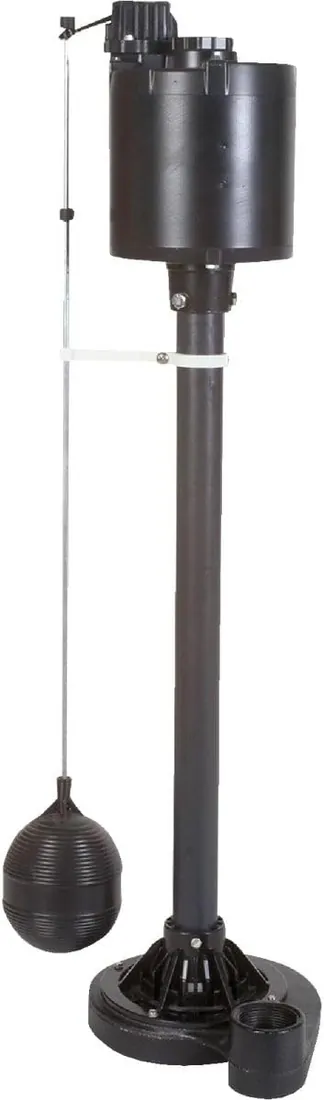
Star Water Systems 3CDH Pedestal Sump Pump
Cast iron base column pump that fits a 12 in pit with an adjustable rod float.
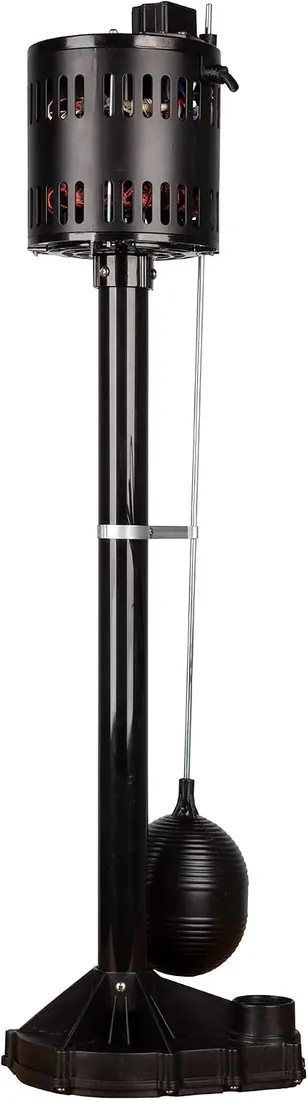
Red Lion RL-SP33PED Pedestal Sump Pump
Polypropylene pedestal pump with a snap-action float for basins 13 in or wider.
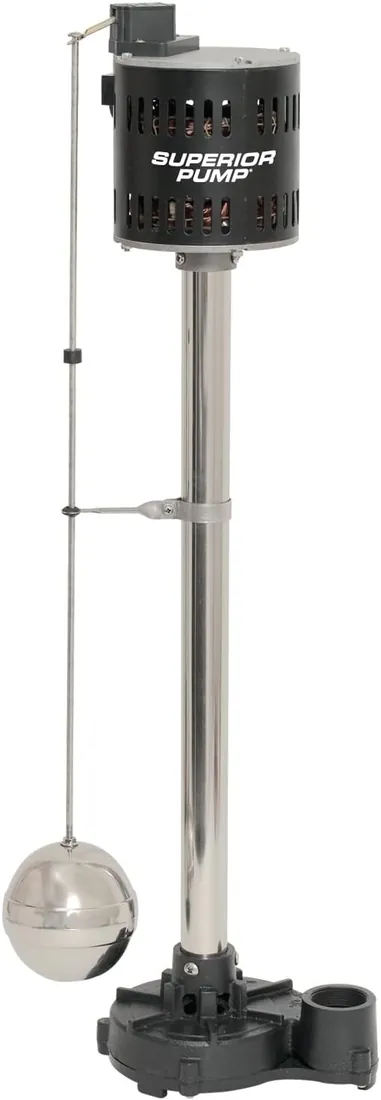
Superior Pump 92551 Pedestal Sump Pump
1/2 HP cast iron pedestal pump with a 1-1/2 in discharge and five-year warranty.
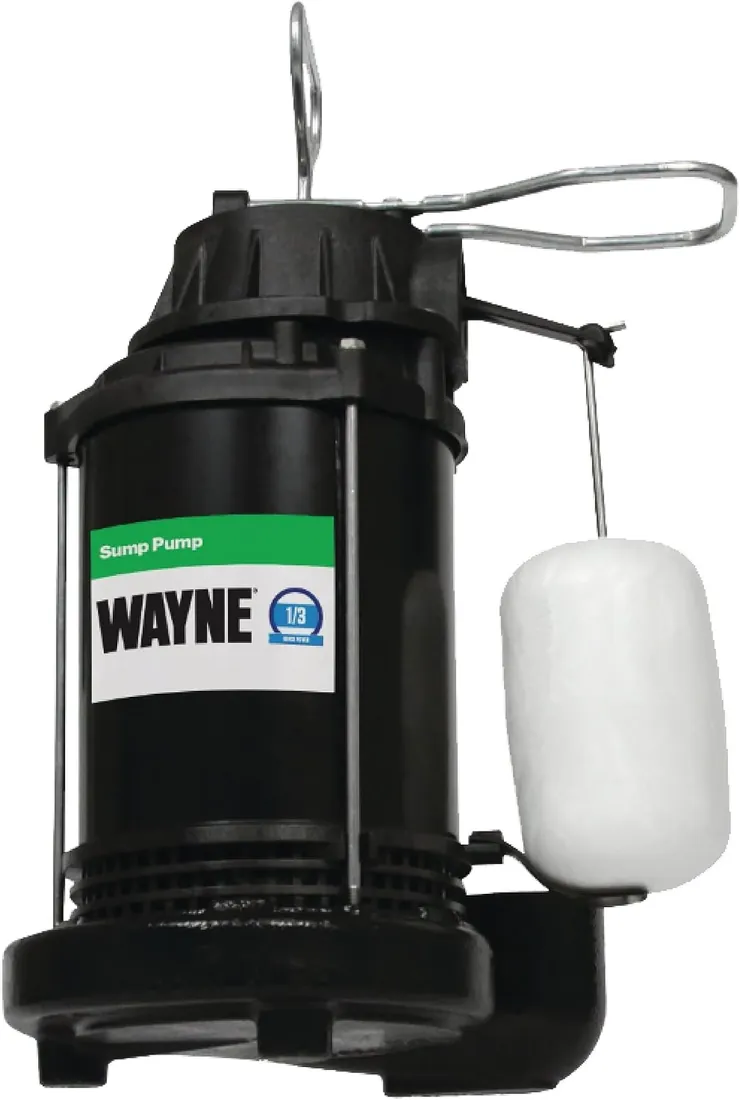
Wayne CDU790 Sump Pump
1/3 HP submersible that fits an 11 in basin and moves more water at a 10 ft lift.
Questions readers ask
Which lasts longer, a pedestal or a submersible sump pump?
Makers do not publish comparable life figures. A pedestal motor stays dry and is easy to service, while a submersible is sealed and cooled by the water. Warranty is one guide: the pedestal pumps here carry one to five years, the Wayne CDU790 three.
Is a pedestal sump pump noisier?
Usually, yes. Its motor sits above the pit, often above the lid line, so you hear it run. A submersible runs under water and under a closed cover, which muffles most of the motor noise.
Can I replace a pedestal pump with a submersible?
If the pit is wide enough, yes. Wayne asks for at least 11 in across for its vertical-float submersibles, and the float needs clearance from the wall. Narrower pits are better served by another pedestal pump.