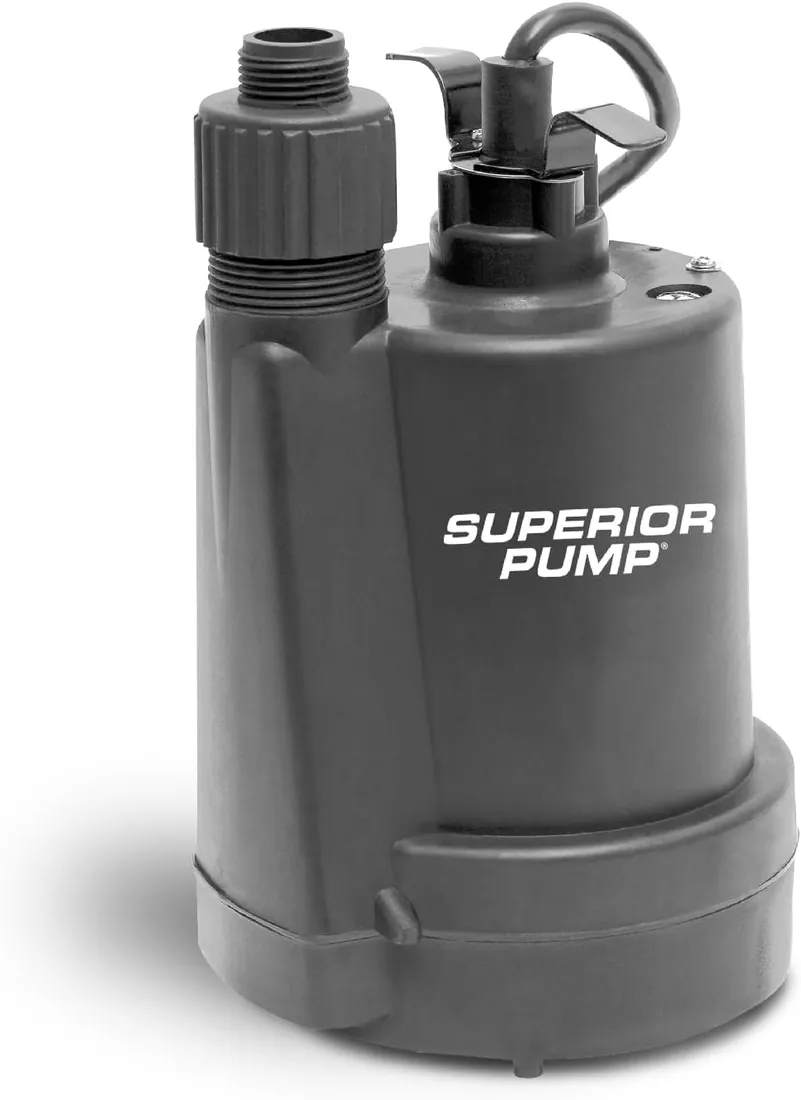
Choose the Superior Pump 91250 when you will stand by the job, need water taken down to a thin film, or must push it higher than about 15 ft.
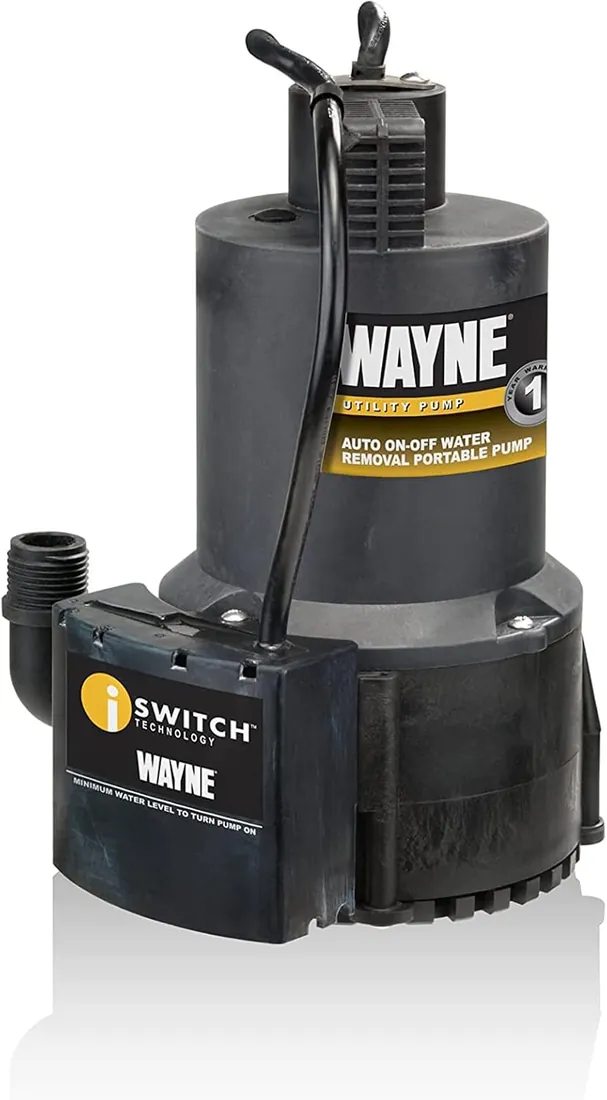
Choose the Wayne EEAUP250 when you want to set the pump down and walk away, since it starts and stops on its own and shuts down before it runs dry.
Key specifications
| Specification | Superior Pump 91250 Thermoplastic Utility Pump | Wayne EEAUP250 Auto On/Off Multi-Use Pump |
|---|---|---|
| Horsepower | 1/4 HP | 1/4 HP |
| Motor | PSC with solid copper windings, dual o-ring seals | Oil-free motor |
| Switch | Manual, user-controlled | iSwitch automatic on/off with dry-run shut-down |
| Flow at 0 ft | 1,800 GPH | 3,100 GPH |
| Flow at 10 ft | 1,200 GPH | 1,600 GPH |
| Flow at 15 ft | Not stated on the product page | 900 GPH |
| Flow at 20 ft | Not stated on the product page | 250 GPH |
| Maximum lift | 25 ft | Not stated; curve ends at 20 ft |
| Drains down to | 1/8 in of surface | About 3/8 in; starts at 1-3/4 in |
| Solids | 1/8 in | Not stated by Wayne |
| Discharge | 1-1/4 in NPT top discharge, 3/4 in GHT adapter | 1-1/4 in NPT, 3/4 in garden hose adapter |
| Cord | 10 ft | 8 ft on the sell sheet, 9 ft in the manual |
| Amps | 3.8 A | Not stated by Wayne |
| Warranty | 1-year limited | 1-year limited |
Figures: Superior Pump 91250 product page; Wayne EEAUP250 multi-use pump sell sheet; Wayne EEAUP250 quick start manual 620005-001 C.
Scorecard
| Criterion | Edge | Why |
|---|---|---|
| Flow at low lifts | Wayne EEAUP250 Auto On/Off Multi-Use Pump | Wayne rates 3,100 GPH with no lift and 1,600 GPH at 10 ft, ahead of Superior's 1,800 and 1,200 GPH. |
| Height it can reach | Superior Pump 91250 Thermoplastic Utility Pump | Superior quotes lift up to 25 ft, while Wayne's chart shows only 250 GPH left at 20 ft. |
| How dry it leaves the floor | Superior Pump 91250 Thermoplastic Utility Pump | The 91250 removes water to 1/8 in of the surface; the EEAUP250 stops at about 3/8 in. |
| Unattended use | Wayne EEAUP250 Auto On/Off Multi-Use Pump | The Wayne starts and stops by itself and protects its seal by shutting off when water runs out. |
| Warranty | Even | Both makers give one year of limited coverage on these pumps, so neither has an edge here. |
Manual control against a built-in sensor
This is the choice that matters most. The Superior Pump 91250 has a manual, user-controlled switch: plug it in and it runs, unplug it and it stops. That suits jobs where someone is watching, like draining a hot tub, a water heater or a flooded corner, but it will run dry if you walk away and the water runs out.
The Wayne EEAUP250 carries Wayne's iSwitch. It starts when water reaches 1-3/4 in, waits two seconds to purge air, pumps down to about 3/8 in and then stops. If it senses no water is moving, it shuts itself down. You can leave it on a flat roof or in a window well during a storm. The automatic sensor needs the pump kept upright, and Wayne warns against defeating it. Our guide to automatic and manual pumps covers the same trade-off on pool covers.
Flow at each height
With no lift, the Wayne is far stronger on paper: 3,100 GPH against 1,800 GPH. At 10 ft the gap narrows to 1,600 GPH against 1,200 GPH, still a clear lead for the Wayne. Wayne also publishes 900 GPH at 15 ft and 250 GPH at 20 ft, which shows its output falling away fast above head height.
Superior publishes only two points for the 91250 and a maximum lift of 25 ft. So for draining a pool cover or a basement floor where the hose runs out of a window, the EEAUP250 empties water sooner. For pushing water up a stairwell or over a tall wall, the 91250's higher rated lift is the safer bet, even though its exact flow up there is not published.
Remember that lift is only part of the load. A long garden hose adds friction of its own, so a pump draining a hot tub across a yard behaves as if the lift were several feet higher than it looks. Running the full 1-1/4 in discharge instead of the hose adapter keeps more of the rated flow on either pump, and laying the hose flat without kinks matters as much as the pump you choose.
How low each pump drains
Superior says the 91250 removes water down to 1/8 in of the surface, which is close to a damp floor. Its bottom suction draws through a serviceable intake screen, and its vortex impeller passes particles up to 1/8 in, so a little grit does not stop it.
The EEAUP250 needs at least 1-3/4 in of water before it starts, and stops at about 3/8 in above the hard surface it sits on. For most puddles that is fine, and the leftover film can be mopped. If you want a floor as dry as a pump can leave it, the manual Superior goes further. Our guide on pumping out a flooded basement covers setting either pump on a hard, flat spot.
Build, motor and fittings
Both bodies are thermoplastic. Superior calls the 91250 shell fiberglass-reinforced and fits a PSC motor with solid copper windings and two o-ring motor seals. Wayne lists an oil-free motor and a centrifugal impeller, with the pump assembled in the USA and weighing 11 lb on the sell sheet. Superior lists a liquid temperature range of 35 to 120 degrees F for its pump.
Fittings are close to identical. Each has a 1-1/4 in NPT discharge and a 3/4 in garden hose adapter, and neither includes a hose. Wayne reminds owners to use a hose washer and to unwind the hose before starting. The 91250 has the longer cord at 10 ft; Wayne's own papers disagree on the EEAUP250, giving 8 ft on the sell sheet and 9 ft in the quick start manual.
Where neither pump belongs
Wayne is blunt that the EEAUP250 is not a sump pump and that using it in a sump voids the warranty. It also rules out septic tanks, sewage and any liquid that is not clear. Superior markets the 91250 for hot tubs, pools, ponds, standing basement water, job sites and boats.
Neither belongs in a permanent sump pit, which needs a pump built for constant automatic duty and a check valve. If you are unsure which kind of pump a job needs, our guide to sump pumps and utility pumps sets out the differences. Both makers back these pumps for one year, so keep the receipt with the pump.
Who each one fits
The Superior Pump 91250 Thermoplastic Utility Pump fits if
- You will be present for the whole job.
- The water must climb more than about 15 ft.
- You want the floor left nearly dry.
- A 10 ft cord helps reach the outlet.
The Wayne EEAUP250 Auto On/Off Multi-Use Pump fits if
- The pump may run unattended, as on a pool cover.
- Most jobs involve little or no lift.
- You want protection against running dry.
- Clearing standing water quickly matters more than height.
- You can live with about 3/8 in of water left behind.
Questions readers ask
Which is better, the Superior Pump 91250 or the Wayne EEAUP250?
Neither is better in every case. The Wayne is the easier pump for unattended jobs and moves more water at low lifts. The Superior drains lower and reaches higher, but you have to switch it on and off yourself by plugging and unplugging it.
Can I use either one as a sump pump?
Not as a permanent sump pump. Wayne says using the EEAUP250 in a sump voids its warranty. The 91250 has a manual switch, so it cannot cycle on its own. For a sump pit, choose a pump built for automatic sump duty with its own float switch.
Can I attach a garden hose to both pumps?
Yes. Each has a 1-1/4 in NPT discharge and comes with a 3/4 in garden hose adapter. A wider hose or pipe on the full discharge gives more flow, and Wayne asks for a hose washer and an unkinked hose for correct operation.
Why does the Wayne stop before the floor is dry?
Its iSwitch sensor turns the pump off at about 3/8 in of water to protect the shaft seal, which depends on water for lubrication. The pump restarts only when water rises back to 1-3/4 in. That safeguard is what lets it run without anyone watching.
Final verdict
Both are compact 1/4 HP thermoplastic pumps with the same fittings and warranty, so the decision rests on how you will use them. The Wayne EEAUP250 is the set-and-forget choice that clears standing water quickly at low lifts. The Superior Pump 91250 needs an attentive owner but pulls water down to a film and reaches higher. Think about whether you will be there when the water runs out.