A circulator pump moves heated water from the boiler through radiators, baseboard or radiant floor tubing and back again. Because the loop is closed and full, the pump only overcomes friction, so it is small: Grundfos's UPS15-58FC draws up to 89 watts. Closed heating loops use cast iron circulators; open potable hot water systems need bronze or stainless steel housings.
What a circulator does
In a hot water heating system, the boiler heats water and the circulator pushes it around the loop. Radiators or tubing give off the heat and the cooler water returns to the boiler. Without the pump, water would move only by convection, slowly and unevenly. Because the system is sealed and full of water, the pump does not lift water against gravity; it only overcomes the friction of the pipes, fittings and boiler.
That is why circulators are small. Grundfos says its UP series motors range from 1/25 to 1/6 hp, and its three-speed UPS15-58FC is a 1/25 hp pump covering flows up to 17 GPM and heads up to 19 ft. Grundfos describes the series as designed for heating systems, also suitable for domestic hot water circulation and for cooling and air conditioning loops.
How a wet-rotor circulator is built
Most home circulators are wet-rotor pumps. Grundfos explains that the pump and motor form one unit with no shaft seal, only two gaskets, and bearings lubricated by the pumped water. Its UP series uses ceramic shafts and radial bearings, a carbon thrust bearing and a stainless steel rotor can. With no seal to wear, these pumps run quietly for years.
The housing material depends on the water. Grundfos says cast iron housings suit closed heating systems with water or water and glycol, while bronze, brass or stainless steel housings are used for potable water in open systems such as hot water recirculation. Its UPS26-99SF stainless model and bronze models serve that open-system role. Never put a cast iron circulator on a domestic hot water line; fresh oxygenated water rusts it.
| Item | Value |
|---|---|
| Motor | 1/25 HP, 115 V, 3 speeds |
| Power at speed 1 / 2 / 3 | 60 / 80 / 89 W |
| Flow range | 0-17 U.S. GPM |
| Head range | 0-19 ft |
| Volute | Cast iron |
| Max fluid temperature, closed system | 230 °F (200 °F with check valve) |
Figures: Grundfos UPS15-58FC product data.
Mounting rules and supply vs return
Grundfos is firm on one point: the pump must always be installed with the motor shaft horizontal, with the terminal box to one side and the conduit entry facing down. The pump itself can sit in a vertical or horizontal pipe. A vertical shaft lets air collect around the bearings and shortens their life.
Whether to put the circulator on the supply or the return is a system design question. Many modern designs place it on the supply, pumping away from the expansion tank's connection point, which keeps system pressure up at the pump inlet. Grundfos's data shows why inlet pressure matters: the hotter the water, the more inlet pressure the pump needs, rising to 15.6 psi at 230 °F on the UPS15-58FC. Follow the boiler maker's piping diagram.
Circulator vs zone valve
A house with several heating zones can control them two ways. With zone valves, one circulator serves the whole system and motorized valves open the loops that call for heat. With zone pumps, each loop has its own circulator that starts when its thermostat calls. Zone valves need only one pump and are quick to wire; zone pumps avoid valve failures and let each loop be sized on its own.
Integrated check valves matter in pump zoning. Grundfos says the removable check valve in its FC models prevents thermo-siphoning, the slow gravity flow that heats a zone that is not calling, and improves zone valve close-off. Three-speed models such as the UPS15-58FC let one pump suit many zones by changing speed.
Why a circulator squeals or rattles
Noise usually means air or low pressure. Air trapped in the pump housing or loop makes a gurgling or rattling sound and starves the wet-rotor bearings of water. Grundfos notes that minimum inlet pressure exists to avoid cavitation noise and bearing damage at high temperatures, so low system pressure can make an otherwise healthy pump noisy. Purge air from the loop, check that the system pressure matches the boiler maker's setting, and confirm the shaft is horizontal.
A steady squeal or grinding after air is purged points to worn bearings or debris in the impeller, and on a wet-rotor circulator the usual fix is a new pump or cartridge. Speed matters too: a pump set higher than the loop needs can whistle through valves. Try a lower speed on three-speed models.
- Check the boiler pressure gauge against the maker's setting.
- Purge air through the bleed valves or purge station.
- Confirm the circulator shaft is horizontal.
- Try a lower speed on a multi-speed pump.
- Replace the pump if grinding continues after air is cleared.
Choosing a replacement
For a like-for-like swap, match the flange size, housing material and performance of the old pump. The Grundfos UPS15-58FC is a common three-speed replacement, and the single-speed Grundfos UP15-42F suits smaller loops. If the system also circulates domestic hot water, choose a bronze or stainless model rather than cast iron. Check the cross-reference tables makers publish, since Grundfos lists equivalents for common Taco and Bell and Gossett models.
Common mistakes
- Mounting the circulator with the motor shaft vertical.
- Using a cast iron circulator on potable hot water.
- Running the loop at low pressure so the pump cavitates.
- Leaving air in the system after work on the boiler.
- Choosing the highest speed when a lower one heats the zone.
Products that fit
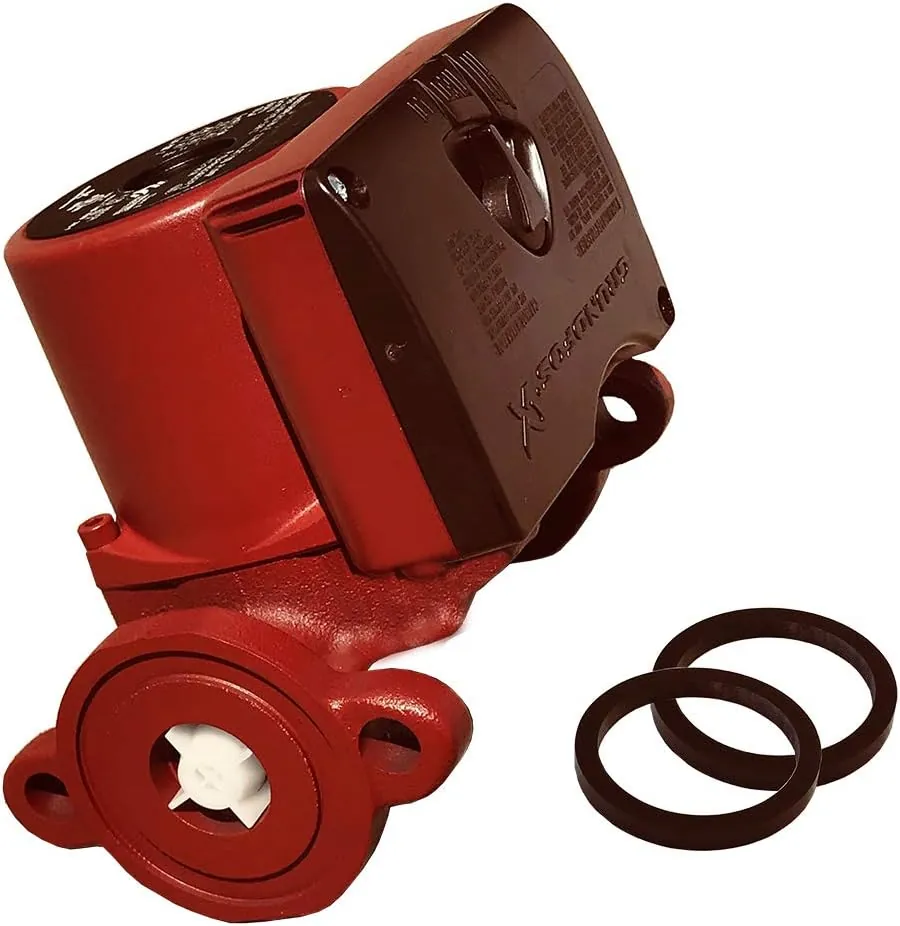
Grundfos UPS15-58FC Circulator Pump
1/25 HP pump with three speeds and a check valve you can remove, for zoned loops.
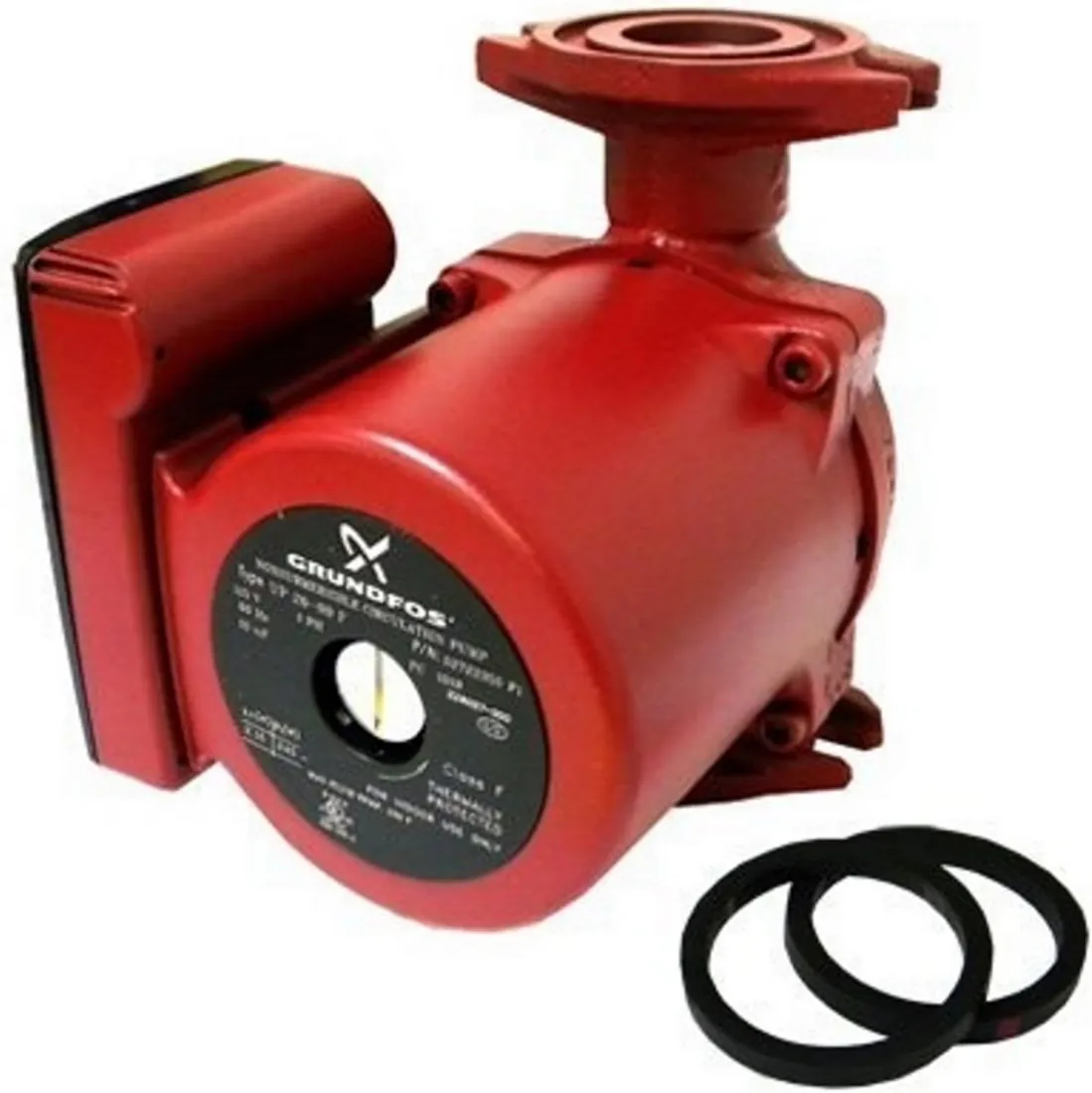
Grundfos UP15-42F SuperBrute Circulator
Single-speed Grundfos circulator in cast iron for smaller closed heating loops.
Taco 007-F5 Cast Iron Circulator
Widely used Taco cartridge circulator in cast iron for hydronic heating systems.
Questions readers ask
What does a circulator pump do on a boiler?
It keeps heated water moving from the boiler through radiators or floor tubing and back. The loop is closed and full, so the pump only overcomes friction, which is why circulators are small, low-wattage pumps.
Should a circulator be on the supply or return?
It depends on the system design, and the boiler maker's diagram is the authority. Many modern systems pump away from the expansion tank on the supply side, which helps keep inlet pressure up and avoids cavitation.
Why is my circulator pump squealing?
Usually trapped air or low system pressure. Purge the air and check the pressure gauge. Grundfos ties minimum inlet pressure to avoiding cavitation noise. If it still squeals, the bearings may be worn and the pump due for replacement.
Can a boiler circulator be used for hot water recirculation?
Only if its housing is bronze or stainless steel. Grundfos says cast iron housings are for closed heating systems, while potable hot water systems need bronze, brass or stainless steel.