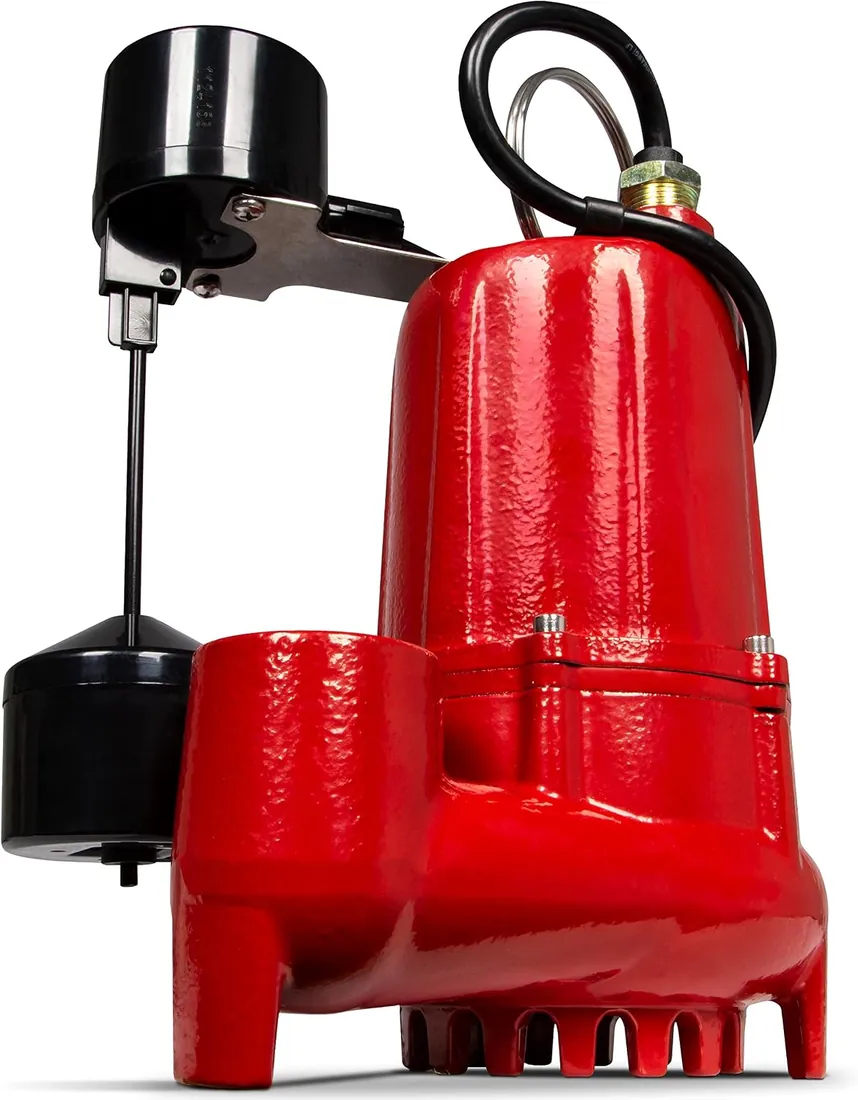
Choose the Red Lion RL-SC50V when the discharge climbs above 20 ft, the circuit is shared or you want a piggyback switch you can bypass for a manual run.
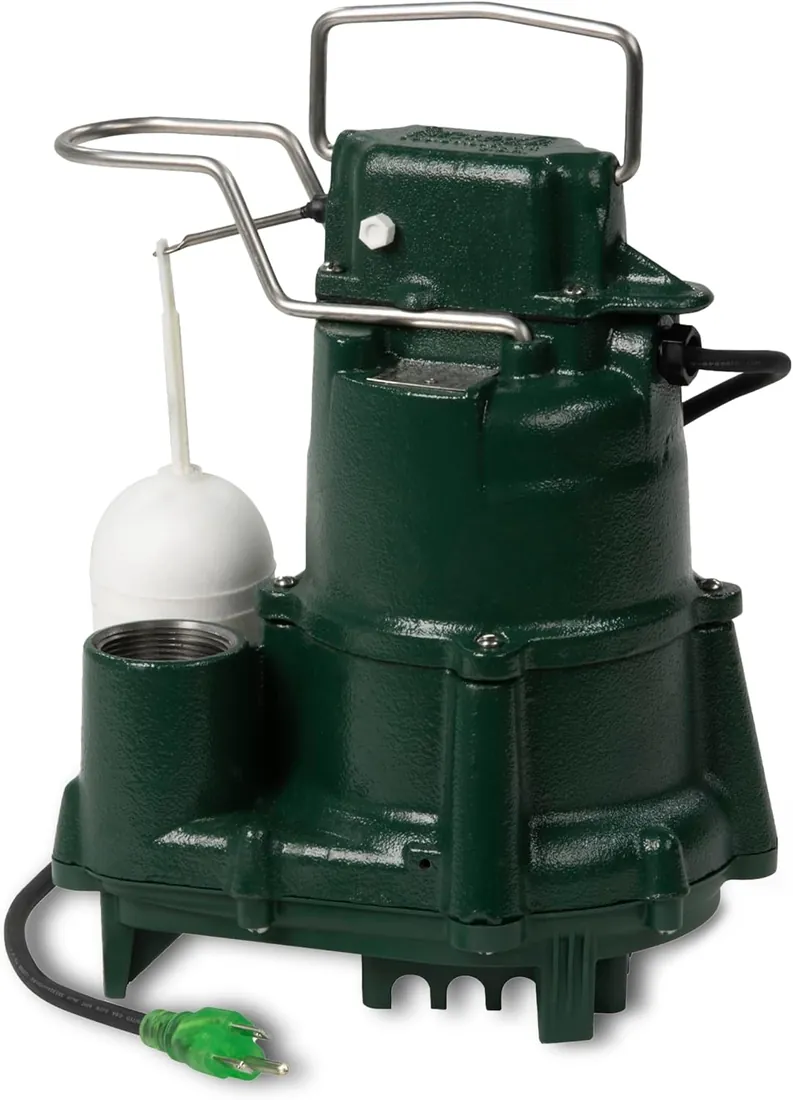
Choose the Zoeller M98 when total head stays between about 5 and 15 ft and you want the most water per minute, a float sealed inside the pump body and 1/2 in solids handling.
Key specifications
| Specification | Red Lion RL-SC50V Sump Pump | Zoeller M98 Flow-Mate Sump Pump |
|---|---|---|
| Horsepower | 1/2 HP | 1/2 HP |
| Amps at 115 V | 5.3 A | 9.4 A |
| Motor | PSC, oil-filled | Permanent split capacitor, oil-filled, 1725 RPM |
| Flow at 5 ft | 3,840 GPH (about 64 GPM) | 72 GPM (about 4,320 GPH) |
| Flow at 10 ft | 3,000 GPH (about 50 GPM) | 61 GPM (about 3,660 GPH) |
| Flow at 15 ft | 2,220 GPH (about 37 GPM) | 45 GPM (about 2,700 GPH) |
| Flow at 20 ft | 1,440 GPH (about 24 GPM) | 25 GPM (about 1,500 GPH) |
| Shut-off head | 28 ft | 23 ft |
| Switch | Vertical float on a piggyback plug; on 7 in, off 2.25 in (manual) | Integral snap-action float in a stainless guard; on 9-1/2 in, off 3 in |
| Solids | 3/8 in semi-solids | 1/2 in spherical solids |
| Smallest basin | 15 in diameter, 18 in deep | Not stated on the data sheet |
| Discharge | 1-1/2 in FNPT | 1-1/2 in NPT |
| Cord | 10 ft | 9 ft (automatic) |
| Warranty | 3 years from purchase | 3-year limited |
Figures: Red Lion RL-SC series cast iron sump pump owner's manual 998495; Zoeller technical data sheet FM2779, Flow-Mate Model 98; Red Lion cast iron sump pumps product page; Zoeller Model 98 product page.
Scorecard
| Criterion | Edge | Why |
|---|---|---|
| Flow at a 10 ft lift | Zoeller M98 Flow-Mate Sump Pump | Zoeller's table shows 61 GPM at 10 ft; Red Lion's 3,000 GPH works out to about 50 GPM. |
| Very tall discharge runs | Red Lion RL-SC50V Sump Pump | Red Lion rates shut-off at 28 ft against 23 ft for the M98, so it keeps a trickle going higher. |
| Current draw | Red Lion RL-SC50V Sump Pump | At 5.3 A the Red Lion draws a little over half the M98's 9.4 A, which helps on a shared or older circuit. |
| Solids passage | Zoeller M98 Flow-Mate Sump Pump | The M98 vortex impeller passes 1/2 in spheres; Red Lion quotes 3/8 in semi-solids. |
| Warranty | Even | Each maker gives three years from the date of purchase on these models. |
Two curves that cross
Both pumps carry the same 1/2 HP rating, but their performance shapes differ. The Zoeller M98 is the stronger pump through the range most basements use. At 5 ft it moves 72 GPM against roughly 64 GPM for the Red Lion, and at 10 ft the figures are 61 GPM against about 50 GPM. By 15 ft the M98 still leads with 45 GPM to about 37 GPM.
At 20 ft the two meet, with 25 GPM for the Zoeller and about 24 GPM for the Red Lion. Above that the Red Lion keeps going until 28 ft, while the M98 stops at 23 ft. Red Lion publishes its figures in gallons per hour and Zoeller in gallons per minute, so the conversions here are rounded. The sizing calculator helps you find your own total head.
Amps, motors and the circuit
The biggest surprise in the paperwork is the current. Red Lion's manual lists 5.3 A for the RL-SC50V, while Zoeller's model chart gives 9.4 A for the M98 at 115 V. Both use permanent split capacitor motors in oil, so the difference reflects each maker's motor and hydraulic design rather than a different motor type.
Lower current matters when the pump shares a circuit, when a long run of thin wire feeds the outlet, or when you plan to size a generator or inverter around it. Both makers still ask for a dedicated, grounded outlet with no extension cord. Our guide to sump pump amps and power use explains how to plan the circuit.
Current also shapes what happens when the lights go out. A portable generator or a large inverter has to cover the starting surge as well as the running load, and a pump with the lower nameplate figure leaves more headroom for a furnace blower or a freezer on the same unit.
Piggyback float against a built-in switch
The RL-SC50V has two cords. The pump plugs into the back of the float switch plug, and the switch plug goes into the wall. That piggyback layout lets you run the pump by hand during an emergency by plugging the pump cord straight into the outlet, and a worn switch can be replaced on its own. Red Lion's manual gives start and stop levels of about 7 in and 2.25 in.
The M98 carries its snap-action float on the pump body inside a stainless guard, with one cord and no plug-in switch. It starts later, at 9-1/2 in, and stops at 3 in. Fewer cords in the pit means less to snag, but a failed switch on the Zoeller means a repair at a service center rather than a swap at the outlet. See our guide to float switch types for the trade-offs.
Pit size and installation details
Red Lion is specific about the pit. The vertical-float RL-SC50V needs a basin 15 in across and at least 18 in deep, set on a hard surface rather than clay or gravel. It asks for a free-flow check valve that passes 3/4 in solids, mounted horizontally or at no more than 45 degrees, and a relief hole of 1/8 or 3/16 in between the pump and the check valve.
Zoeller's data sheet for the M98 does not state a minimum basin for the automatic model. Its installation sheet asks for a vent hole of about 3/16 in below the check valve and recommends a pit of 18 in or more only when a variable-level tethered switch is used. In a narrow pit, the Zoeller's built-in switch is the easier fit.
Build, solids and upkeep
Both pumps are cast iron where it counts. Zoeller casts the cap, motor housing and pump housing of the M98 and finishes them in powder-coated epoxy, with stainless hardware. Red Lion describes the RL-SC series as cast iron submersibles with a clog-resistant design for 3/8 in semi-solids. The M98 passes larger debris, up to 1/2 in spheres, which matters in an older pit with loose gravel.
Red Lion warns that its pump is for clear water only, not ponds or debris-laden pits, and that running it dry voids the warranty. Zoeller limits the M98 to dewatering, sump and light effluent use. Either way, clear the pit, test the float with a bucket of water a few times a year and keep the vent hole open.
Who each one fits
The Red Lion RL-SC50V Sump Pump fits if
- The pipe climbs more than 20 ft before it turns outside.
- The pump will share a circuit or run from backup power.
- You want to run the pump by hand during an emergency.
- Your basin is at least 15 in across and 18 in deep.
The Zoeller M98 Flow-Mate Sump Pump fits if
- Total head sits between about 5 and 15 ft.
- Your sump is tight, with little room beside the pump.
- Loose gravel or debris could reach the intake.
- You prefer one cord and a switch sealed inside a guard.
- You want the LED plug that shows the outlet is live.
Questions readers ask
Is Red Lion or Zoeller better for a sump pump?
Neither wins outright on these two models. The Zoeller M98 moves more water at the lifts most basements use, while the Red Lion RL-SC50V reaches higher, draws less current and has a replaceable piggyback switch. Your total head and pit size decide which fits.
Why does the Red Lion draw so much less current?
Red Lion lists 5.3 A for the RL-SC50V and Zoeller lists 9.4 A for the M98, both at 115 V with permanent split capacitor motors. The makers do not explain the gap. The Zoeller does deliver more flow at low and medium lifts, which accounts for part of the difference.
Can I swap one for the other without new plumbing?
Usually yes. Both use a 1-1/2 in threaded discharge. Check that the pit is at least 15 in across if you move to the Red Lion, and that the M98's 9-1/2 in start level sits below the inlet pipe if you move to the Zoeller.
Are these pumps suitable for sewage?
No. Red Lion says the RL-SC series is for clear water and not for sewage, sand or debris, and Zoeller says its dewatering pumps must not be used in pits handling raw sewage. Use a sewage ejector pump for toilets and other waste.
Final verdict
This is a contest between capacity and reach. The Zoeller M98 empties a typical basement pit faster and tolerates bigger debris, as long as the discharge stays under about 20 ft. The Red Lion RL-SC50V gives up some flow at ordinary lifts but keeps pumping to 28 ft, draws about half the current and lets you replace or bypass the switch. Measure total head and pit width, then pick.