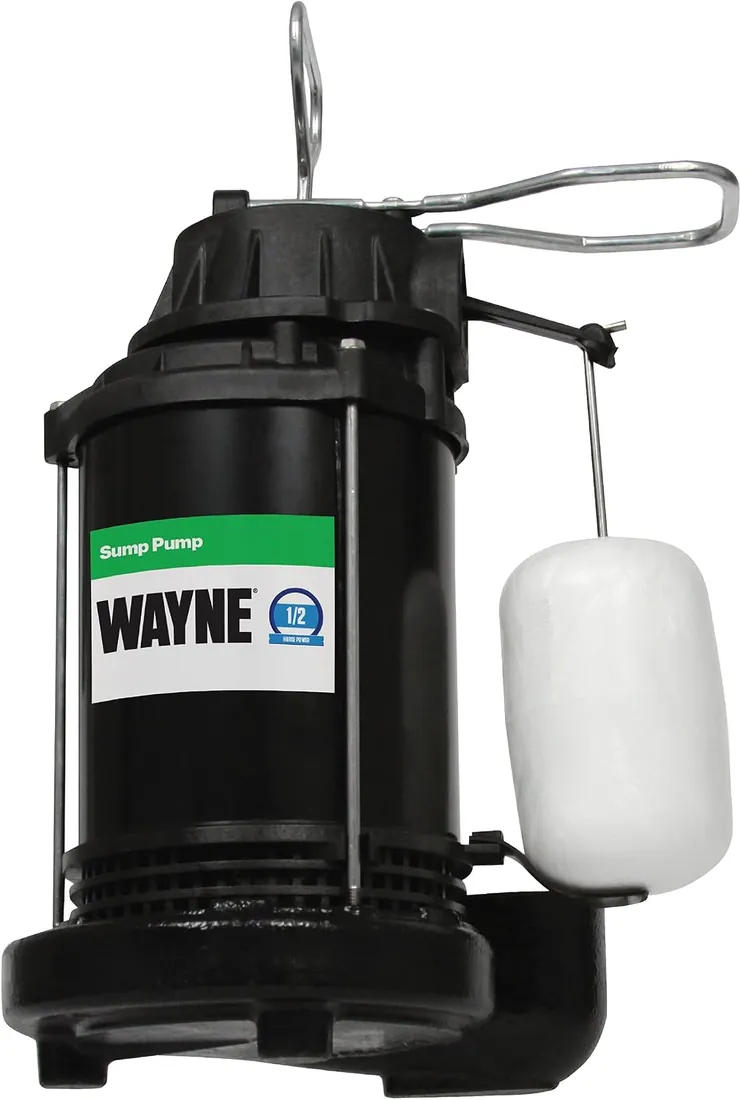
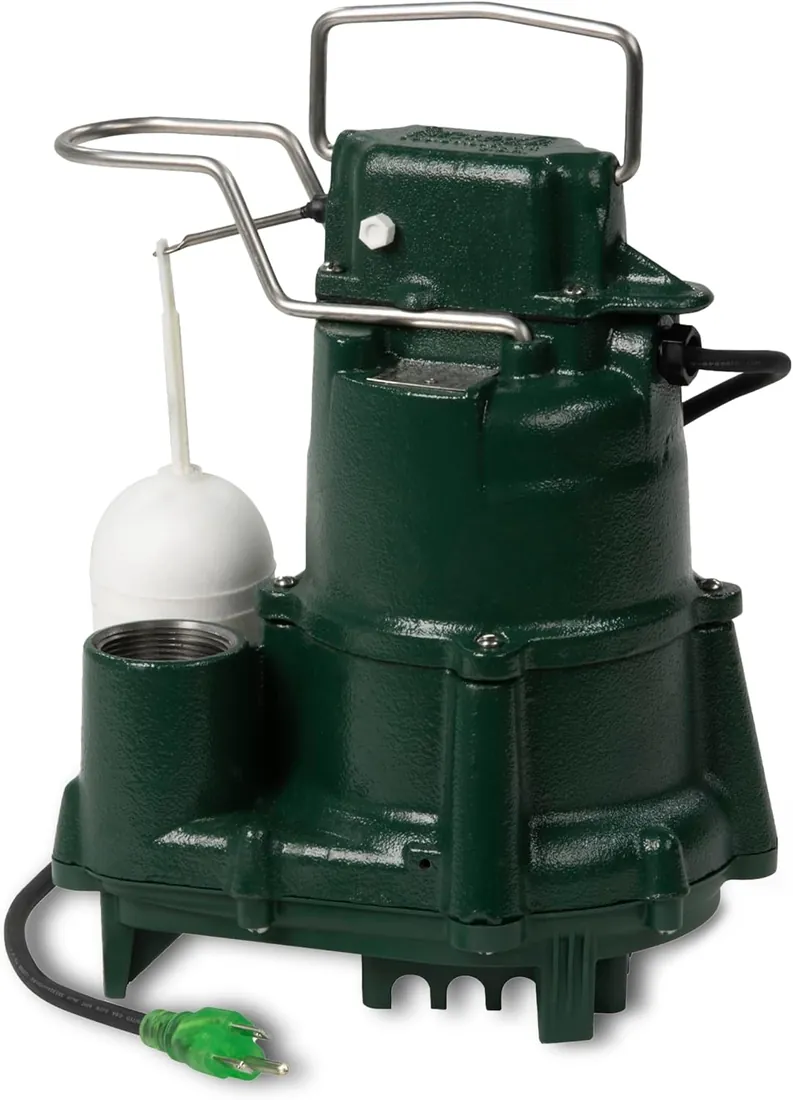
Choose the Wayne CDU800 when you want the most flow at every published lift, a top-suction intake that ignores silt, and a lighter pump with replaceable float kits.
Choose the Zoeller M98 when you want cast iron around the motor, a stated shut-off head, a compact guarded switch and nonautomatic or 230 V versions in the same family.
Key specifications
| Specification | Wayne CDU800 Sump Pump | Zoeller M98 Flow-Mate Sump Pump |
|---|---|---|
| Horsepower | 1/2 HP | 1/2 HP |
| Motor | Split capacitor, 120 V, oil-filled | Split capacitor, 115 V, 1725 RPM, oil-filled |
| Max flow | 85 GPM (5,100 GPH) | 72 GPM |
| Flow at 5 ft | 75 GPM (4,500 GPH) | 72 GPM |
| Flow at 10 ft | 64 GPM (3,840 GPH) | 61 GPM |
| Flow at 15 ft | 51 GPM (3,060 GPH) | 45 GPM |
| Flow at 20 ft | 34 GPM (2,040 GPH) | 25 GPM |
| Shut-off head | Not stated by Wayne | 23 ft |
| Intake | Top suction, glass-reinforced polycarbonate impeller | Bottom intake, vortex impeller, 1/2 in solids |
| Switch | Vertical float with guard, on 9 in, off 4 in | Integral float, on 9-1/2 in, off 3 in |
| Housing | Epoxy-coated steel, cast iron volute | Cast iron cap, motor and pump housing |
| Weight | 22 lb | 36 lb |
| Cord | 8 ft | 9 ft automatic |
| Warranty | 3-year limited | 3-year limited |
Figures: Wayne CDU800 product page; Zoeller technical data sheet FM2779, Flow-Mate Model 98; Wayne CDU790 and CDU800 sell sheet; Zoeller Model 98 product page.
Scorecard
| Criterion | Edge | Why |
|---|---|---|
| Flow at a 15 ft lift | Wayne CDU800 Sump Pump | Wayne lists 51 GPM at 15 ft for the CDU800 against 45 GPM for the M98. |
| Silty or gravelly pits | Wayne CDU800 Sump Pump | Top suction keeps the Wayne intake above the debris that settles on the pit floor. |
| Metal around the motor | Zoeller M98 Flow-Mate Sump Pump | Zoeller casts the M98 motor housing in iron; Wayne uses coated steel above an iron volute. |
| Room needed in the pit | Zoeller M98 Flow-Mate Sump Pump | The M98 switch works in its own guard; Wayne asks for an 11 in basin and side clearance. |
| Weight to lift | Wayne CDU800 Sump Pump | Wayne's sheet lists 22 lb; Zoeller's chart gives 36 lb for the automatic M98. |
Which models stand for each brand
When people ask whether Wayne or Zoeller makes the better sump pump, they are usually choosing between the brands' best-known basement pumps. At the 1/2 HP size that many homeowners step up to, those are the Wayne CDU800 and the Zoeller M98 Flow-Mate. Both are automatic plug-in pumps with a 1-1/2 in NPT discharge and three-year limited warranties, so either can replace the other in most pits.
For the smaller 1/3 HP pair, the Wayne CDU790 and the Zoeller M53 are the matching models, and the Liberty against Wayne page covers the CDU790 in detail.
Flow at each lift
Both makers publish real tables, which makes this an easy comparison. Wayne lists the CDU800 at 85 GPM to start, 75 GPM at 5 ft, 64 GPM at 10 ft, 51 GPM at 15 ft and 34 GPM at 20 ft. Zoeller lists the M98 at 72 GPM at 5 ft, 61 GPM at 10 ft, 45 GPM at 15 ft and 25 GPM at 20 ft, with shut-off at 23 ft.
The gap is small at low lift and grows with height. At 10 ft the two are within a few gallons a minute; at 20 ft the Wayne moves roughly a third more water. Wayne does not state a shut-off head for the CDU800, so if your discharge climbs past 20 ft, ask the maker before relying on either pump. For ordinary basements, both are well matched to the job, and the sizing calculator shows where your own head falls.
Top suction against a bottom intake
Wayne draws water into the CDU800 from the top of the pump. Silt, sand and small stones settle on the pit floor, so an intake above them is less likely to clog, and Wayne says the design also prevents air lock, so no weep hole is required.
The M98 draws water from below through a non-clogging vortex impeller that passes 1/2 in spherical solids. Zoeller's optional stand raises the pump 2 in off the floor to keep debris away. In a clean plastic basin the difference is small; in an older pit with a gravel or clay floor, the Wayne design avoids a common cause of jams.
Switch levels and clearance
The Wayne float rides on a vertical rod inside a guard, starting at about 9 in and stopping at about 4 in. Wayne asks for a basin of at least 11 in and an inch of clearance between the switch and the wall, and it sells float and float-top kits so the switch can be renewed without a new pump.
The Zoeller switch is a float-operated mechanical switch built into the pump, starting at about 9-1/2 in and stopping at about 3 in. It needs very little side room, which suits a crowded pit with a backup pump beside it. Our switch types guide compares the two designs in more depth.
Housing, bearings and weight
Zoeller casts the M98 cap, motor housing and pump housing in iron and runs the shaft in oil-fed cast iron bearings, at 1725 RPM. The result is a heavy pump at 36 lb, with a lot of metal to shed heat into the water.
Wayne wraps the CDU800 motor in epoxy-coated steel over a cast iron volute and seal plate, with stainless fasteners, John Crane carbon and ceramic seals and ball bearings in a sealed oil bath, which Wayne promotes for very quiet running. The sell sheet gives 22 lb. Coated steel does the job well as long as the coating stays intact, so avoid dragging the pump across concrete.
Versions, cords and care
The M98 is one member of a family that includes nonautomatic N98 and E98, the 230 V D98 and piggyback-float BN98 and BE98 builds, plus Zoeller's LED plug on the standard model. The CDU800 is a single automatic 120 V pump with an 8 ft cord, while the automatic M98 ships with 9 ft.
Maintenance is routine for both. Wayne suggests inspecting three to four times a year for pump movement and debris on the float. Zoeller recommends a full check at least every three months and a vent hole of about 3/16 in below the check valve. Either way, run a bucket of water through the pit before the wet season.
Think about the backup too. At 1/2 HP, either pump is usually the primary in a pit that floods often enough to justify a second line of defence. The Zoeller's compact guarded switch leaves more room for a battery pump alongside it, while the Wayne's float needs its clear inch to the wall. Sketch the pit from above with both pumps in place before you commit.
Who each one fits
The Wayne CDU800 Sump Pump fits if
- The pit floor collects silt or gravel that could clog a bottom intake.
- The discharge climbs toward 20 ft and every extra gallon a minute counts.
- The basin is at least 11 in across with room beside the float.
- You would rather lift a 22 lb pump and replace a float kit than a pump.
The Zoeller M98 Flow-Mate Sump Pump fits if
- You want cast iron around the motor and bearings that run in oil.
- The pit is crowded, with a backup pump or pipes beside the primary.
- You need a stated shut-off head to plan a tall discharge.
- A 230 V, nonautomatic or piggyback version may be needed later.
Questions readers ask
Is Wayne or Zoeller the better sump pump brand?
Both build solid 1/2 HP pumps with three-year warranties. Wayne's CDU800 posts higher flow at every published lift and uses top suction, while Zoeller's M98 has more iron, a compact switch and more versions. Choose by pit conditions rather than brand.
Which pumps more water, the CDU800 or the M98?
On the makers' tables, the Wayne: 64 GPM against 61 GPM at 10 ft, and 34 GPM against 25 GPM at 20 ft. The gap is small at low lift and grows as the pipe climbs higher.
Can I swap a Zoeller M98 for a Wayne CDU800?
Usually. Both use a 1-1/2 in NPT discharge and start near 9 in. Check the pit is at least 11 in across with an inch of clearance beside the Wayne float, especially if a backup pump shares the basin.
Does either pump need a weep hole?
Wayne says the CDU800's top-suction design avoids air lock and needs none. Zoeller builds a vent into the M98 housing and still recommends drilling a hole of about 3/16 in in the discharge pipe below the check valve.
Final verdict
At 1/2 HP these brands trade different strengths. The Wayne CDU800 wins on published flow, top-suction debris handling and weight, provided the basin gives its float room. The Zoeller M98 wins on iron construction, a compact switch for crowded pits and a broader family of versions. Look at your pit floor and its width, and the right brand usually follows.