Groundwater runs through drain tile into a pit. As it rises, a float switch closes and starts an electric motor that spins an impeller, flinging water out through the discharge pipe. A check valve stops it falling back. When the level drops to the off point, the float opens the switch and the pump stops, typically after removing a few inches of water.
The whole system, from drain tile to yard
A sump pump is the last link in a basement drainage system. Perforated drain tile around the footings, or under the slab, collects groundwater and carries it by gravity to a basin set below the floor. That basin, the sump pit, is where the pump lives. Wayne describes sump pumps simply as automatic pumps that remove groundwater from sump pits to keep basements from flooding, and its installation drawing labels every part you will find in a typical pit.
Working from the bottom up: the basin, the drain tile inlet entering its side, the pump standing on the floor of the basin, the float switch beside it, a rigid discharge pipe rising out of the pit, a check valve in that pipe, a sealed lid with a gasket, and a grounded GFCI outlet nearby. A vent pipe appears on the drawing too, for basins with sealed lids. Outside, the discharge pipe should release the water at least 3 ft from the foundation, so it does not soak straight back into the drain tile.
- Groundwater enters the drain tile and flows to the pit.
- The rising water lifts the float to its on level.
- The motor spins the impeller and water is pushed up the pipe.
- The check valve holds the column of water when the pump stops.
- The float drops to its off level and the switch opens.
The switch: what tells the pump to start
Every automatic sump pump has an on level and an off level. A float rides on the water, and when it rises far enough it closes an electrical switch. When the pump has drawn the water back down, the float falls and opens the switch again. The gap between the two levels is the amount of water removed on each run.
Makers publish these levels, and they differ more than you might expect. Wayne's vertical float on the CDU790 starts at about 9 in and stops at about 4 in. Zoeller's M53 hides a float-operated switch inside a cast guard, starting at 7-1/4 in and stopping at 3 in. A tethered float swings on a cord and gives a wider range; Wayne's tether models run from about 13 in down to about 7 in. The off level always leaves some water in the pit, because the motor relies on it for cooling and the impeller must stay submerged.
| Pump | Switch design | On level | Off level |
|---|---|---|---|
| Zoeller M53 | Float switch inside a guard | 7-1/4 in | 3 in |
| Wayne CDU790 | Vertical float on a guard | About 9 in | About 4 in |
| Wayne tether models | Tethered float | About 13 in | About 7 in |
| Red Lion RL-SP33PED | Pedestal float stem | 8–10 in | 3–5 in |
Figures: Zoeller technical data sheet FM2778, Mighty-Mate series; Wayne submersible sump pump manual 600002W-001 J; Red Lion RLSP33PED pedestal sump pump owner's manual 998776.
Motor and impeller: how the water moves
Inside the pump, an electric motor turns a shaft that ends in an impeller, a spinning disc with vanes, inside a housing called the volute. Water enters through a screened inlet near the center of the impeller and is flung outward by the spin, building pressure in the volute that pushes it up the discharge pipe. This is a centrifugal pump, the same principle as most water pumps.
Details vary by maker. Zoeller's M53 uses a non-clogging vortex impeller that passes 1/2 in solids. Wayne's CDU pumps draw water from the top of the pump rather than the bottom, which Wayne says avoids air lock and keeps debris on the pit floor out of the impeller. Most submersible motors sit in a sealed housing filled with oil, which carries heat into the surrounding water, and almost all carry an automatic resetting thermal protector that switches the motor off if it overheats and restarts it once it cools.
Check valve and discharge pipe
When the pump stops, the water standing in the discharge pipe wants to fall back into the pit. Without a check valve, that water refills the pit and restarts the pump, so it runs far more often than it needs to. Wayne lists the check valve as required with its sump pumps, and requires rigid PVC pipe, since flexible hose lets the pump move and can stop the switch working.
The check valve also explains the small hole drilled in some discharge pipes. With a full column of water held above the valve, air can get trapped around the impeller, which then spins without pumping. A tiny relief hole, or a built-in anti-airlock port in the volute, lets that air escape. Wayne's top-suction design is meant to avoid the problem without a hole. The check valve guide covers placement and noise.
How a pedestal sump pump works
A pedestal pump does the same job with the motor out of the water. The volute and impeller sit at the bottom of the pit on a base, a long column rises from it, and the motor sits on top of the column above the basin. Instead of a float on a cord, a float on a vertical stem rides up and down; two rubber stoppers on the stem push a switch lever on the motor at the top and bottom of the travel. Moving the lower stopper changes the off level.
Red Lion's RL-SP33PED shows the trade-offs. It needs a basin at least 13 in across and 18 in deep, its on level is 8 to 10 in, and its flow drops from 3,300 GPH at zero lift to 600 GPH at 15 ft, with shut-off at 16 ft. Pedestal motors are easy to reach and suit narrow pits, but they are louder and generally less powerful than submersibles of similar horsepower. The pedestal vs submersible guide compares them in full.
Alarms and backup pumps
A sump pump has no way to tell you it has failed. Wayne's manual advises an independent high-water alarm or a backup pump wherever high water could cause damage. An alarm is a separate float set above the pump's on level that sounds when the water passes it. A battery backup pump sits higher in the pit with its own float and runs from a 12 V battery when the main pump fails or the power is out. Some systems, like Wayne's ESP25n, sound a short tone each time the backup starts so you know it has had to run.
To see how often a pump will start in your pit, try the basin cycle calculator. To compare complete backup setups, see the battery backup sump pump list.
Common mistakes
- Using flexible hose for the discharge, which lets the pump shift and jam its switch.
- Leaving out the check valve and letting the pipe drain back into the pit.
- Setting a pump on gravel or soil, where grit reaches the impeller.
- Discharging next to the foundation so the water returns to the drain tile.
- Relying on one pump with no alarm in a basement that would flood without it.
Products that fit
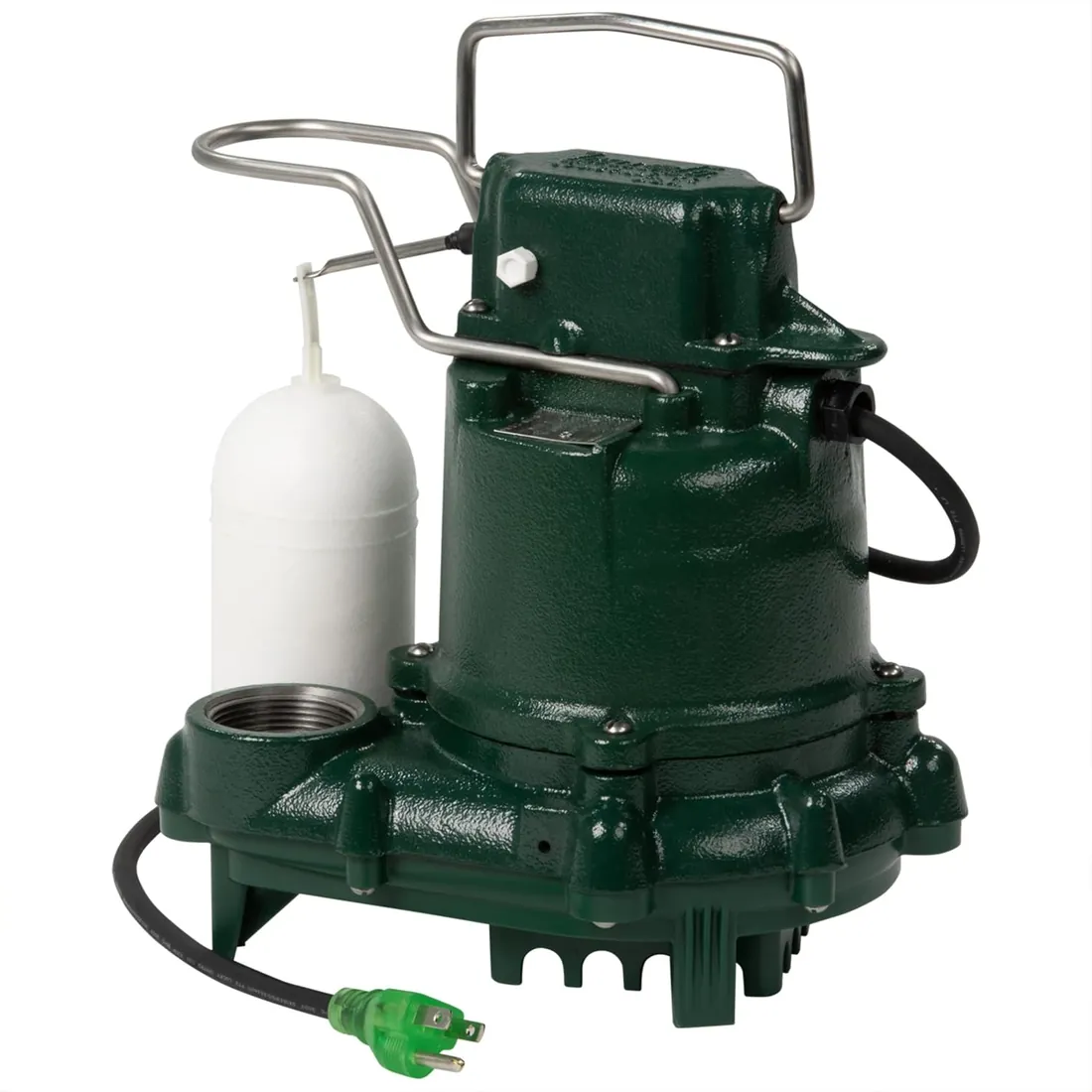
Zoeller M53 Mighty-Mate Sump Pump
Submersible with a guarded float switch and a vortex impeller for small solids.
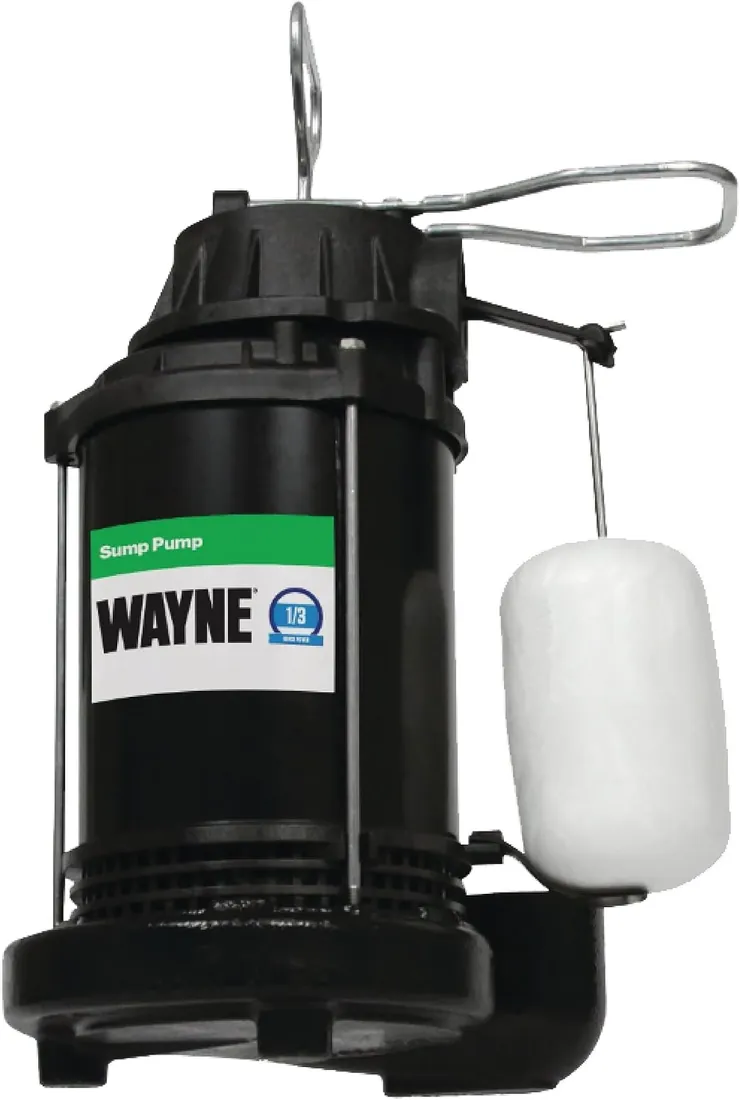
Wayne CDU790 Sump Pump
Top-suction submersible with an exposed vertical float and an oil-filled PSC motor.
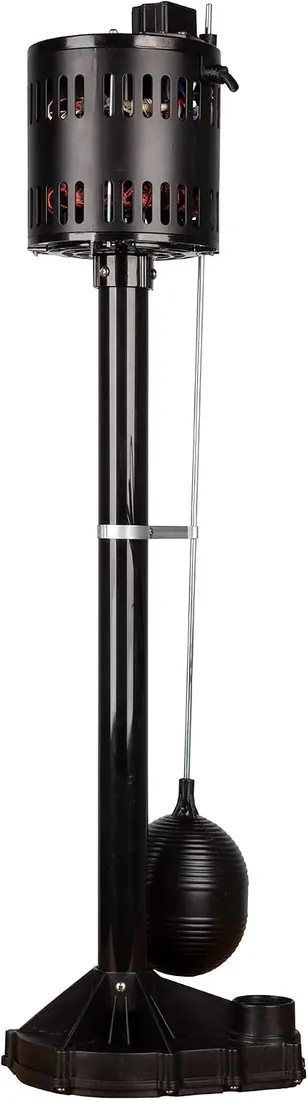
Red Lion RL-SP33PED Pedestal Sump Pump
Pedestal design with the motor above the pit and a float on a stem.
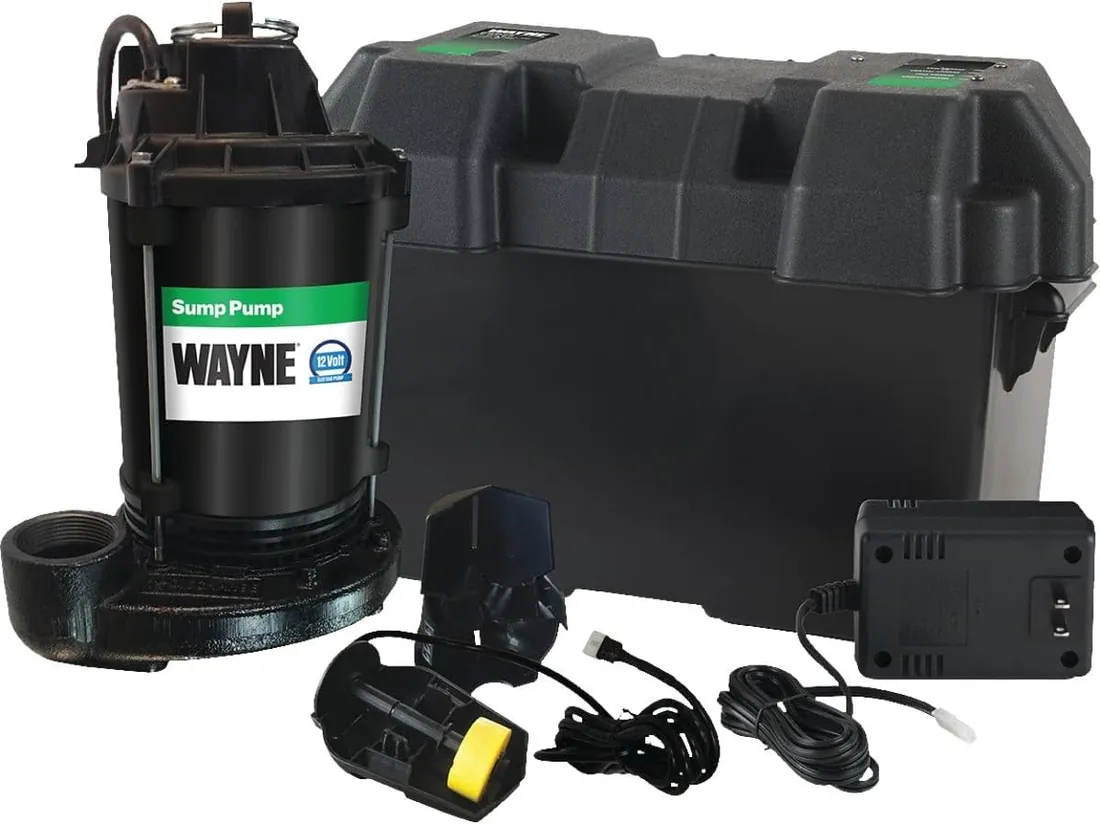
Wayne ESP25n Battery Backup Sump Pump
12 V backup pump that runs when the main pump or the power fails.
Questions readers ask
Does a sump pump run all the time?
No. It only runs when the float reaches its on level and stops at the off level. How often that happens depends on inflow and pit size. A pump that runs nonstop is either facing more water than it can move or has a stuck switch.
Where does the water from a sump pump go?
Out through the discharge pipe to the outside, away from the house. Wayne asks for the water to be released at least 3 ft from the foundation, and for exposed lines to slope downward so they drain and do not freeze.
Why does a sump pump need a check valve?
Without one, the water left in the discharge pipe falls back into the pit each time the pump stops. That refills the pit and restarts the pump, wasting energy and wearing the switch. Wayne lists a check valve as required.
What is the difference between a pedestal and a submersible sump pump?
A submersible sits entirely in the water with a sealed motor. A pedestal keeps the motor on a column above the pit and uses a float on a stem. Pedestals are easier to service; submersibles are quieter and usually stronger.