Confirm the old pump has really failed, then match the new one on horsepower, voltage, 2-wire or 3-wire design and flow at your pumping depth. Shut off and lock out power, release system pressure, then pull the drop pipe through the pitless adapter without letting the cable carry the weight. Reinstall at the maker's depth, start with the discharge throttled, and reset the tank precharge.
Make sure the pump is the problem
Pulling a submersible is a big job, so rule out everything above ground first. Red Lion's troubleshooting guide begins with a voltage check at the fuse box, through the pressure switch and at the control box or disconnect. A failed pressure switch, a blown capacitor in a 3-wire control box, or a waterlogged tank all imitate a dead pump.
If the pump runs but delivers little water, Red Lion and Flotec list a low well level, a plugged intake screen, a stuck check valve and worn impellers. Only the last two truly require pulling the pump. A drop pipe leak can be found on the way up: Red Lion suggests raising the pipe one length at a time until water stands in it.
Match the replacement to your well
Read the old pump's tag or the control box label. Match the horsepower, the voltage and the wiring type, since a 3-wire motor needs its control box and a 2-wire motor does not. Then check flow at your actual pumping depth, not the headline gallons per minute. Flotec's 2-wire table shows how quickly output falls with depth at a fixed 40 PSI at the well head.
Flotec also sets limits for its 2-wire pumps: they pump to a depth of 300 ft for the larger models, and the drop pipe rating must suit the depth. It calls for 100 PSI polyethylene to 100 ft, 160 PSI polyethylene to 220 ft and galvanized steel beyond that. For a jet pump, Red Lion's RJS pumps use a 1-1/4 in suction and 1 in discharge, so check that your piping matches before you order.
| Pump | Power | 20 ft to water | 100 ft | 200 ft |
|---|---|---|---|---|
| Flotec FP2211 | 1/2 HP, 115 V | 13.2 | 8.1 | Not rated |
| Flotec FP2212 | 1/2 HP, 230 V | 13.2 | 8.1 | Not rated |
| Flotec FP2222 | 3/4 HP, 230 V | 14.8 | 11.7 | 5.2 |
Figures: Flotec 2-wire 4 in submersible well pump sell sheet.
Pulling a submersible pump
Switch off and lock out the breaker, then open a faucet to release pressure. Remove the well cap and lift the drop pipe free of the pitless adapter. Plastic pipe with a light pump can be pulled by hand by two people; long steel strings need a pump hoist. Keep the cable and pipe clean as they come up, and never let the cable carry the pump's weight. Flotec makes that point twice in its manual.
Look at what comes up. Sand or scale on the pump suggests the well needs cleaning before the new pump goes in, and a split or loose joint in the pipe may have been the real fault. Flotec asks for a safety rope of at least 5/16 in twisted polypropylene tied from the pump eye to the well cap, so a broken pipe cannot drop the pump down the hole.
- Lock out power and release system pressure.
- Remove the well cap and free the pipe from the pitless adapter.
- Pull steadily, keeping the cable taped and unkinked.
- Inspect pipe, splices and check valve as they surface.
- Cover the well while it is open to keep debris out.
Reinstalling: depth, splices and cable
Flotec sets the pump at least 15 to 20 ft below the lowest water level reached while pumping, and at least 5 ft above the bottom of the well. Splice the motor leads with heat-shrink or taped butt connectors matched by color, tape the cable to the pipe every 10 ft, and fit centering guides so the cable and pipe do not rub the casing. Use PTFE tape, not pipe dope, on plastic threads.
Above ground, Flotec requires a pressure relief valve between pump and tank that can pass full pump flow at 100 PSI when a precharged tank is used, or 75 PSI with an air-over-water tank. Remove bleeder orifices if you are moving to a precharged tank. The 2-wire vs 3-wire guide covers the electrical side.
First start and the jet pump alternative
Flotec's start-up for a new or disturbed well avoids sand-locking the pump. Fit a gate valve at the well head, open it one third and run until the water is clear, then two thirds, then fully open. Only then connect the system. Set the tank precharge to 2 PSI below the switch cut-in with the tank empty, for example 28 PSI on a 30/50 switch.
A shallow well jet pump is replaced from the surface. Red Lion asks for no check valve between the pump and tank, a relief valve rated for full flow at 75 psi, and a tank precharge of 28 psi because its pump starts at 30 psi; then prime before power. Pumps such as the Flotec FP2212 and Red Lion RJS-50-PREM cover the two cases; the deep well submersible list compares more.
Common mistakes
- Pulling the pump before checking the switch, control box and tank.
- Buying on maximum flow instead of flow at your pumping depth.
- Letting the power cable carry the pump while pulling or lowering.
- Setting the pump too close to the well bottom, where it draws sand.
- Starting a new pump with the discharge wide open in a sandy well.
Products that fit

Flotec FP2212 230 V Submersible Well Pump
Flotec 1/2 HP 2-wire submersible for 230 V, a common straight swap.

Flotec FP2222 3/4 HP Deep Well Submersible Pump
Flotec 3/4 HP 2-wire model that still delivers water at 200 ft to water.

Red Lion RL12G05-3W2V Deep Well Submersible Pump
Red Lion 1/2 HP 3-wire submersible supplied with its control box.
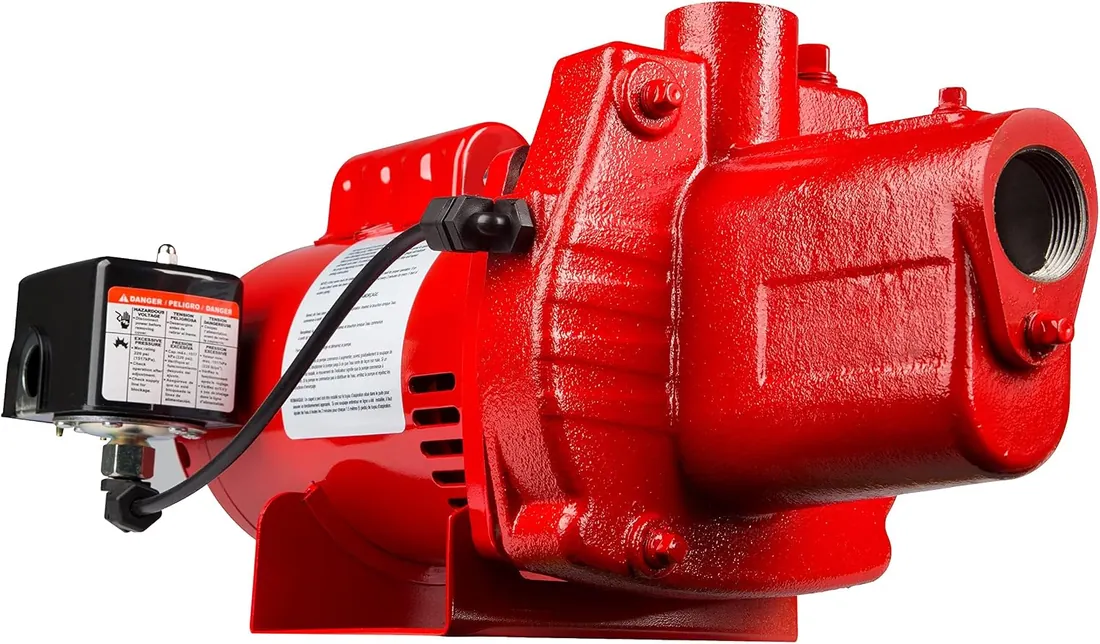
Red Lion RJS-50-PREM Shallow Well Jet Pump
Shallow well jet pump replaced from the surface without pulling pipe.
Questions readers ask
Can I replace a well pump myself?
A jet pump above ground is a reasonable owner job. A submersible needs lifting gear, splicing and electrical work on a live well circuit, and Red Lion and Flotec direct electrical checks to qualified electricians. Many owners hire a well contractor for the pull.
How deep should a submersible well pump be set?
Flotec says at least 15 to 20 ft below the lowest water level reached while pumping and at least 5 ft above the well bottom. Red Lion also asks for at least five feet off the bottom.
Should I replace the pressure tank with the well pump?
Only if it has failed. Check the precharge with the system drained; if it holds and the bladder is sound, keep it and set it to 2 PSI below cut-in. A waterlogged tank should be replaced at the same time.
Do I need a new control box with a new well pump?
For a 3-wire pump, the box must match the new motor's horsepower and voltage. Many 3-wire pumps, such as Red Lion's, ship with a matched box. A 2-wire pump needs no box.