Shut off the pump, drain the house side and read the air valve with a tire gauge. The precharge should sit 2 psi below the pump's cut-in pressure, for example 28 psi on a 30/50 switch. Near zero, or water spitting from the valve, means the bladder has failed and the tank needs replacing. Amtrol warns never to re-pressurize a tank that has lost air or shows corrosion.
How a precharged tank is meant to behave
Red Lion describes the cycle in three steps. The pump starts and pushes water into the tank, keeps running while the water compresses the air charge, and stops at the switch's cut-off pressure. The house then draws from the tank until pressure falls to the cut-in point and the pump starts again. The water you get between starts is the drawdown.
Everything depends on the air charge. Red Lion, Flotec, Pentair and Amtrol all give the same rule: set the precharge 2 psi below the cut-in pressure, measured with no water pressure in the system. Too little air shrinks the drawdown and makes the pump cycle; too much air and the tank barely takes water before the switch shuts the pump off.
| Switch setting | Cut-in | Tank precharge |
|---|---|---|
| 20/40 psi | 20 psi | 18 psi |
| 30/50 psi | 30 psi | 28 psi |
| 40/60 psi | 40 psi | 38 psi |
Figures: Flotec owner's manual FP874, 4 in submersible pumps; Pentair instructions U80-129, adjusting well pump pressure switches.
Checking the air charge
You cannot read the precharge with water in the tank, because the gauge then shows water pressure. Red Lion's method is simple: switch off power to the pump, open a faucet until water stops, and only then put a tire gauge on the air valve at the top of the tank. Amtrol ships its tanks at 38 psig and asks installers to adjust them to match the switch before first use.
- Switch off the pump at its breaker or disconnect.
- Open a faucet near the tank and let the system drain fully.
- Remove the air valve cap and read the pressure with a tire gauge.
- Compare it with the cut-in pressure on your switch, less 2 psi.
- If a little low on a sound, newer tank, add air with a small compressor.
- If water comes out of the air valve, stop: the bladder has failed.
Waterlogged tank: the most common failure
A waterlogged tank has lost its air cushion. The usual signs are a pump that starts every few seconds while a tap runs, a pressure gauge that swings quickly between cut-in and cut-off, and a tank that feels heavy and full right to the top. Red Lion and Flotec both list a waterlogged tank under a pump that starts too often, alongside a faulty pressure switch, leaks in the plumbing and a leaking drop pipe or check valve.
On a bladder tank the cause is almost always a ruptured diaphragm or a slow leak at the air valve. Here Amtrol's warnings are strong: do not add pressure to a tank that has lost air, shows outside corrosion, or has had its pump cycle time shorten compared with when it was new, because loss of air can mean internal corrosion and re-pressurizing could rupture it. Replace the tank instead of topping it up.
A tank that will not fill
If the pump runs but the tank never takes water, look first at the valves. A closed shut-off valve between the tank tee and the tank isolates it completely. Next check the precharge: a tank pumped far above the cut-in pressure leaves almost no room for water, so the switch reaches cut-off within seconds.
If valves and charge are right, the problem is upstream. A pump that cannot build pressure, from a low well, a stuck check valve or a clogged intake screen, never fills the tank either. Red Lion's charts list each of these for a submersible delivering little or no water, and for a jet pump that has lost prime. The well pump guides linked below walk through those checks.
Tank size and placement
Even a healthy tank can be too small. Drawdown shrinks as pressure settings rise, as Amtrol's own table for its Well-X-Trol tanks shows, so a tank that was fine on a 30/50 switch gives less water between starts on 40/60. The Amtrol WX-202 and WX-203 are common sizes for homes.
Placement matters too. Red Lion and Flotec both want the pressure switch within one foot of the tank, and Amtrol asks for the tank as close to the switch as possible so friction and height differences do not make the switch bounce. Do not reduce the pipe size between pump and tank, keep the tank above freezing and below 100 °F, and fit a drip pan where a leak would cause damage.
| Tank | Volume | Drawdown at 30/50 | Drawdown at 40/60 |
|---|---|---|---|
| WX-202 | 20 gal | 6.2 gal | 5.4 gal |
| WX-203 | 32 gal | 9.9 gal | 8.6 gal |
Common mistakes
- Reading the air valve while the tank is still full of water.
- Pumping air into an old tank that has already lost its charge.
- Leaving the factory precharge unchanged on a different switch setting.
- Mounting the pressure switch far from the tank.
- Raising the switch setting without rechecking the tank precharge.
Products that fit
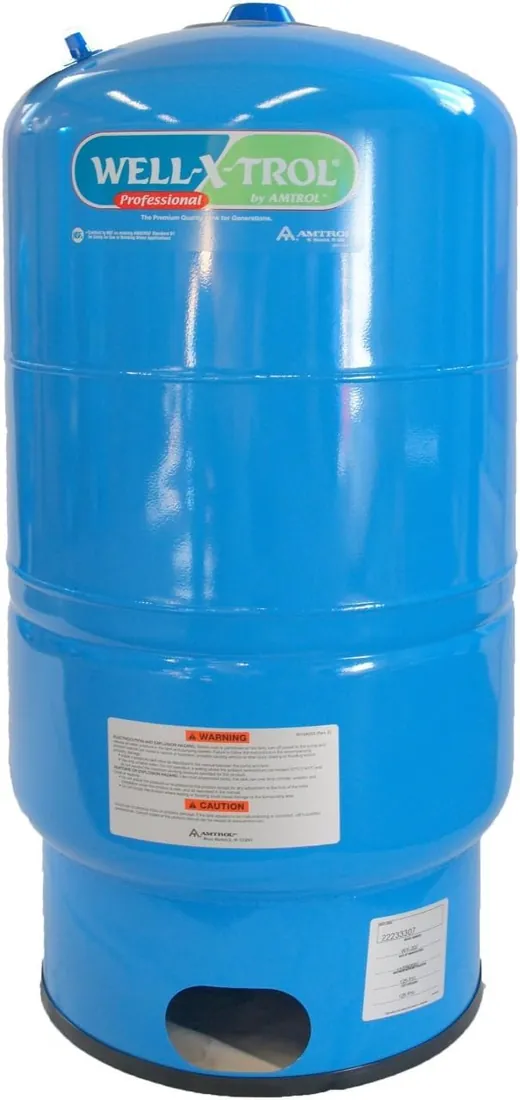
Amtrol WX-202 Well-X-Trol Pressure Tank
Common household Well-X-Trol size with a 20 gallon volume and steel shell.
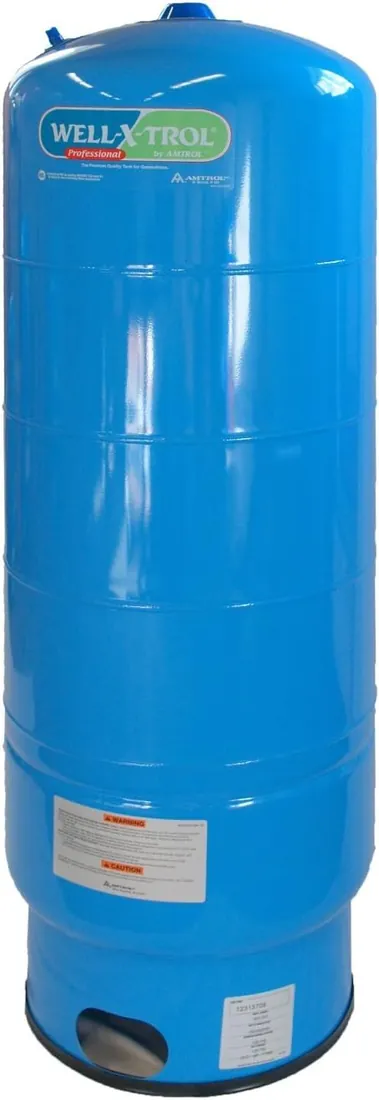
Amtrol WX-203 Well-X-Trol Well Tank
Larger Well-X-Trol that gives more water between each pump start.
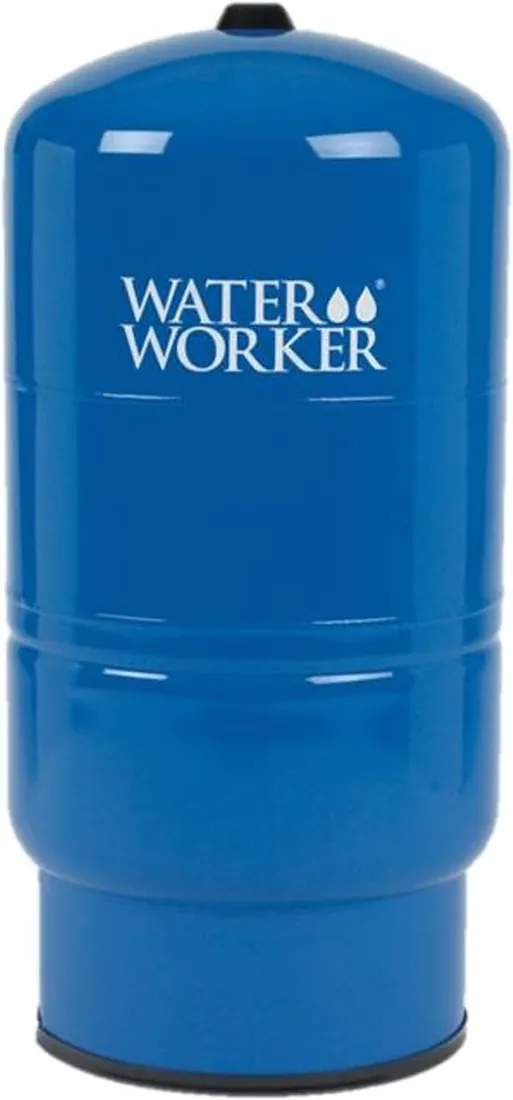
WaterWorker HT-30B Vertical Pressure Tank
WaterWorker vertical tank as an alternative when replacing a failed tank.
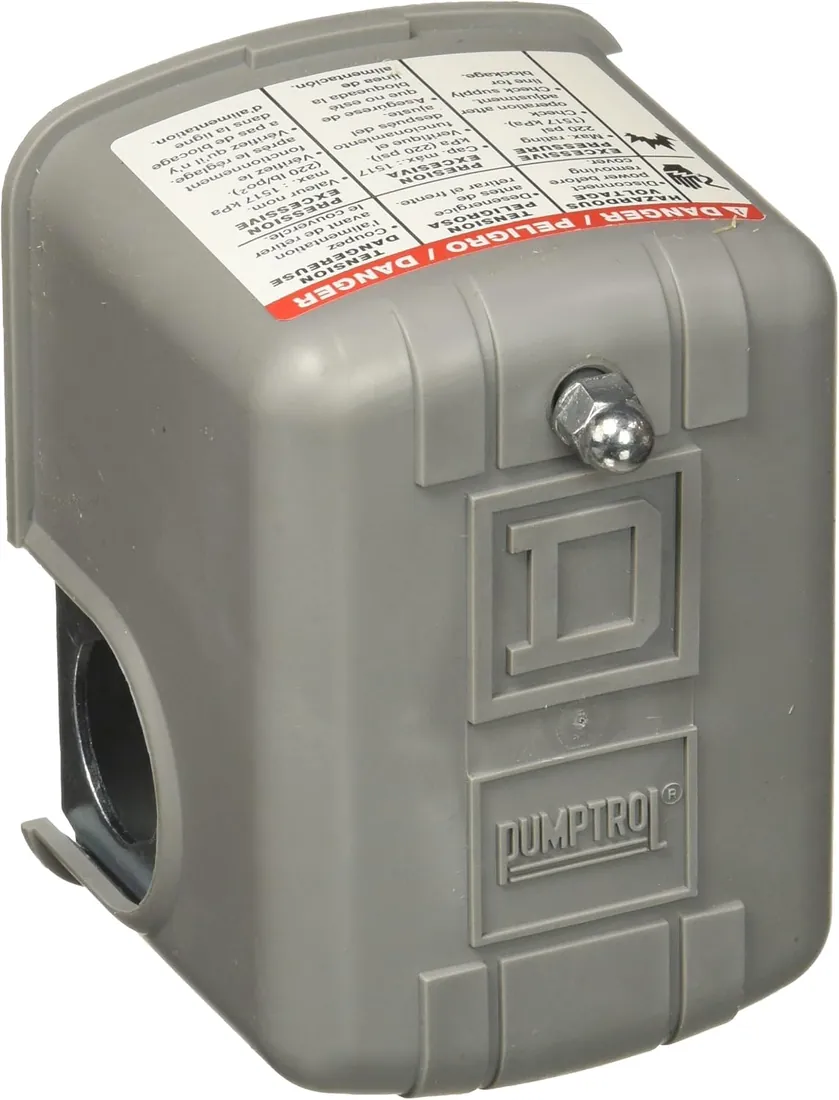
Square D FSG2J21CP 30/50 PSI Pressure Switch
Standard 30/50 pressure switch, paired with a 28 psi tank precharge.
Questions readers ask
How do I know if my well pressure tank is bad?
Rapid pump cycling, pressure that swings quickly, a tank that sounds solid full when tapped, or water from the air valve all point to a failed bladder or lost air charge. Drain the system and read the precharge to confirm.
What should the air pressure be in my well tank?
Two psi below the pump's cut-in pressure, read with the system drained: 28 psi for a 30/50 switch and 38 psi for a 40/60 switch, per Red Lion, Flotec and Amtrol.
Can I recharge a waterlogged pressure tank?
On a bladder tank, a lost charge usually means a failed bladder, and Amtrol warns against adding air to a tank that has lost pressure or shows corrosion. Replacement is the safe fix. Only a new or confirmed-sound tank should be adjusted.
Why is my pressure tank not filling with water?
Check for a closed valve at the tank, a precharge set far above cut-in, and a pump that is not building pressure because of a low well, lost prime or blocked intake. Each stops water reaching the tank.