Shut off the pump's power, open a tap until the gauge reads zero, and disconnect the old tank. Set the new tank's precharge to 2 psi below the pump's cut-in while it is empty, then connect it to the tank tee with the pressure switch, gauge and relief valve close by. Restore power and watch a full cycle. Amtrol says installation should be done by a licensed professional.
Before you start
Amtrol's manuals are written for licensed installers, and say so: its well tanks must be installed by a licensed professional following local and state codes. If you are doing the work yourself, at least follow the same sequence the professionals use. The first rule is in Amtrol's own warning box: before work on the tank, turn off the power to the pump and release all water pressure in the tank and system.
Check the replacement against the old tank. The connection size, the switch setting and the drawdown you need all decide the model. Amtrol's Well-X-Trol vertical models WX-202 and WX-203 have a 1 in NPTF system connection, while the small in-line models use 3/4 in. If the old tank short cycled, it may have been too small; the pressure tank sizing guide uses Amtrol's drawdown tables to pick the size.
| Models | Style | Connection |
|---|---|---|
| WX-101 to WX-103 | In-line | 3/4 in NPTM |
| WX-104 and WX-200 | In-line | 1 in NPTM |
| WX-201 to WX-203 | Vertical stand | 1 in NPTF |
| WX-205 to WX-350 | Vertical stand | 1-1/4 in NPTF |
Figures: Amtrol Well-X-Trol installation and operation instructions 9015-868.
The tank tee and what goes on it
Most installations use a tank tee, a short manifold that screws into the tank's connection and gives ports for everything that has to sit at the tank. Flotec's typical submersible installation drawing shows the parts: the line from the well entering through a union, the pressure switch, a pressure gauge, a relief valve, and the line to the house service. A check valve sits in the line from the well, and a drain is useful for draining the tank later.
Placement matters for two of those parts. Amtrol says the tank should be as close as possible to the pressure switch, to reduce the effect of friction and height differences, and Red Lion's troubleshooting guide lists a switch too far from the tank as a cause of rapid cycling, with the fix of moving it to within one foot. If the tank must be at the end of a long run, Amtrol says to move the switch with it or adjust its setting.
- Union on the inlet from the well for easy removal.
- Tank tee threaded into the tank connection.
- Pressure switch and gauge on the tee.
- Relief valve on the tee or at the tank connection.
- Outlet to the house, with a drain valve.
Removing the old tank
With the pump's breaker off, open a tap on the lowest floor and leave it open until the gauge reads zero and water stops running. Then open the tank drain to empty what remains. A full tank is heavy; a 32 gallon WX-203 weighs 47 lb when empty, and much more when full. Disconnect at the union, unscrew the tee from the old tank if you are reusing it, and clean the threads.
Inspect the tee, the switch and the gauge while they are accessible. A switch whose sensing port is clogged with sediment, or a gauge that never returns to zero, should be replaced now rather than after the new tank is plumbed in.
Set the precharge before filling
This is the step most often skipped. A new tank's air charge must match the pump's switch, and it can only be set correctly while the tank is empty of water. Amtrol's procedure is to remove the air valve cap, check the precharge, and add or release air until it is 2 psi below the pressure switch cut-in, using its own example of 38 psig for a 40/60 switch. Well-X-Trol tanks leave the factory at 38 psig, so on a 30/50 system release air down to 28 psi.
Use a tire gauge and a small compressor or bicycle pump. Amtrol warns that precharge adjustments must be made at ambient temperature, and that only a new tank, or one confirmed free of corrosion, should be adjusted.
| Cut-in | Cut-off | Precharge |
|---|---|---|
| 20 psi | 40 psi | 18 psi |
| 30 psi | 50 psi | 28 psi |
| 40 psi | 60 psi | 38 psi |
Figures: Flotec 4-inch submersible pumps installation and operation manual FP874.
Installing and starting up
Stand the tank on a surface that can carry its full weight with water, vertical only for Well-X-Trol models, out of direct sun and where it will not freeze or exceed 130 °F. Amtrol asks for a drip pan connected to a drain wherever a leak could cause damage. Thread the tee in with lead-free sealant, reconnect the union and fittings, and confirm the relief valve is in place.
Amtrol's relief valve rule for Well-X-Trol tanks is a valve set to open at excessive pressure, 125 psig or more, at the tank connection, able to discharge the pump's capacity at that pressure; the line's maximum working pressure is 150 psig. Amtrol's older precharged-tank manual, for its 125 psig-rated tanks, calls for a relief valve no higher than 100 psi, so match the relief valve to the tank you actually buy. Then restore power, let the pump run to cut-out, open a tap to start a cycle, and check every joint for leaks.
After installation
Watch the gauge through two or three full cycles: the pump should start near the cut-in, stop at the cut-out, and stay off for a while with a tap running. If it cycles rapidly, recheck the precharge with the tank drained. Amtrol asks for a professional check of the whole system yearly, and more often as it ages, and offers a seven-year limited warranty on WX models, registered by serial number.
If the pump itself is part of the job, the shallow well jet pump list and the pressure switch guide cover the other half of the system.
Common mistakes
- Opening the old tank's fittings before draining all system pressure.
- Filling the new tank before setting its precharge.
- Leaving the factory 38 psi charge on a 30/50 system.
- Leaving the switch on a long pipe run away from the new tank.
- Fitting a relief valve set higher than the tank's rating allows.
Products that fit
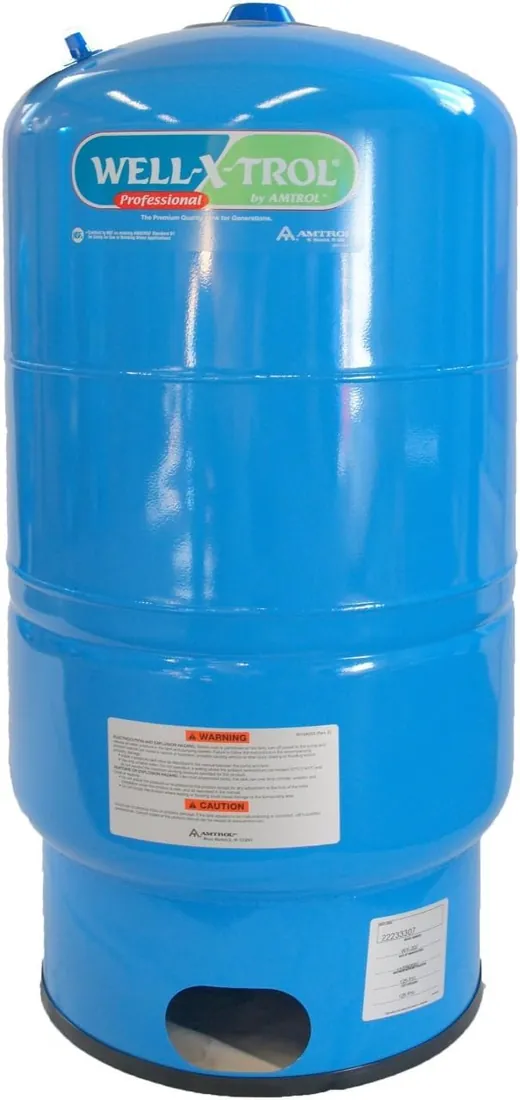
Amtrol WX-202 Well-X-Trol Pressure Tank
Amtrol 20-gallon vertical tank with a 1 in NPTF system connection.
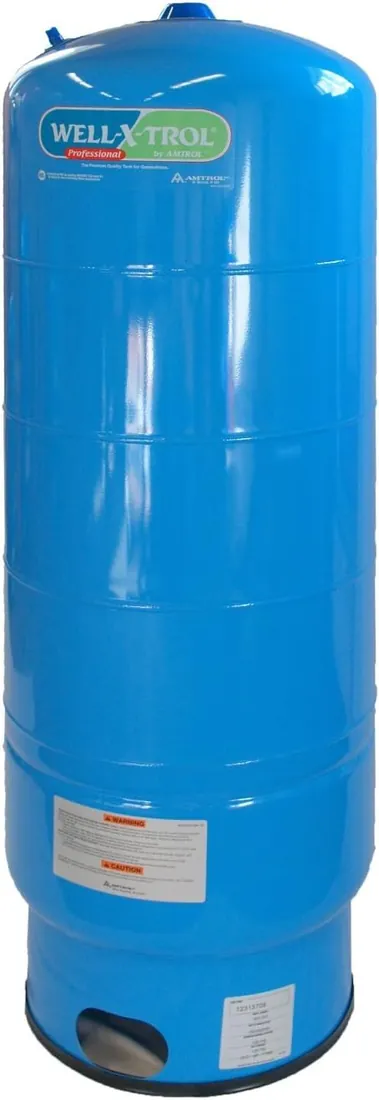
Amtrol WX-203 Well-X-Trol Well Tank
Amtrol 32-gallon vertical tank for larger pumps or more drawdown per cycle.
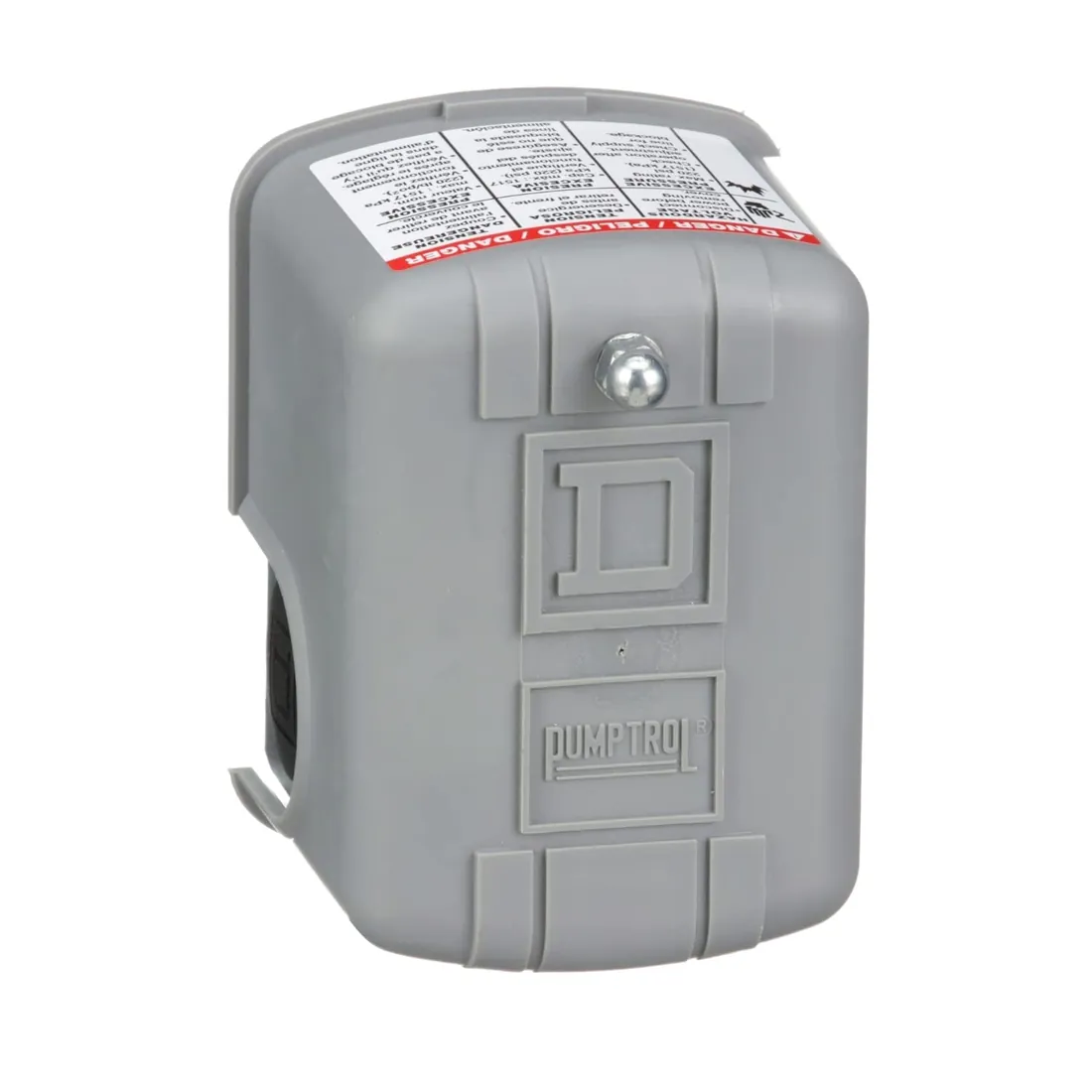
Square D 9013FSG2J24 40/60 PSI Pressure Switch
40/60 switch to fit on the tank tee if the old one is worn.
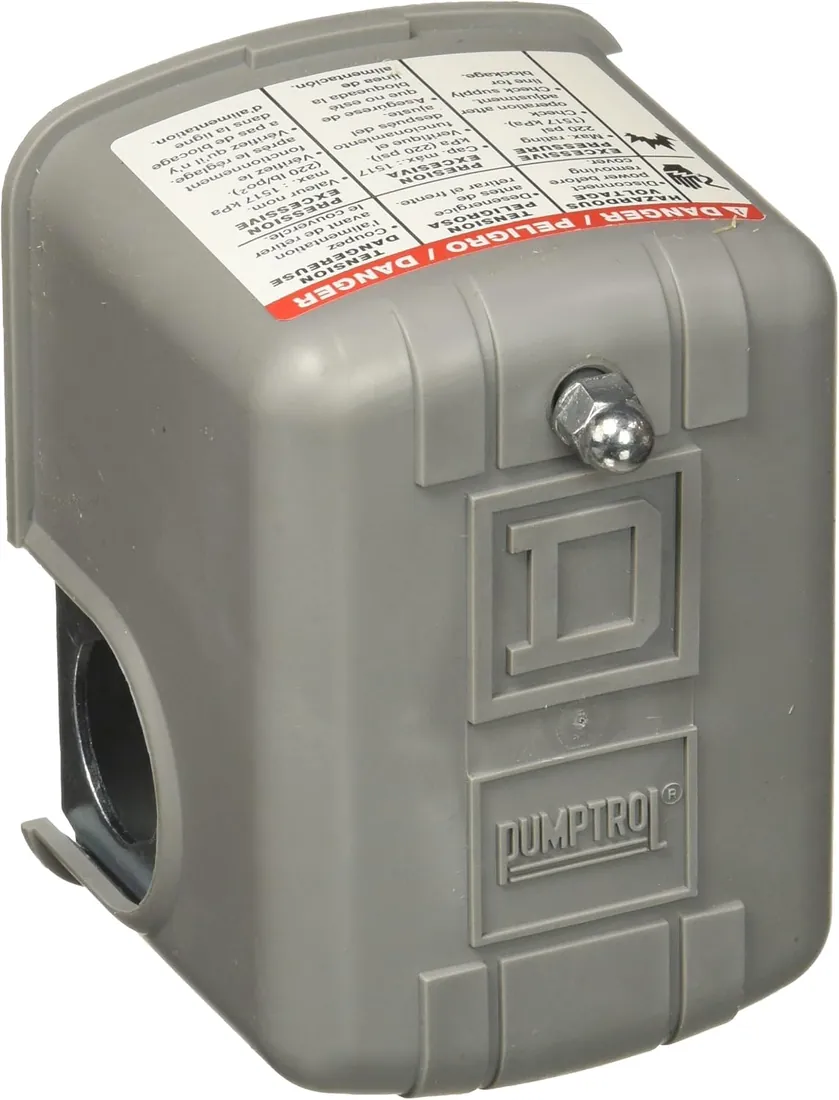
Square D FSG2J21CP 30/50 PSI Pressure Switch
30/50 switch for systems that run at the lower setting.
Questions readers ask
What is a pressure tank tee?
A short fitting that threads into the tank and gives ports for the pressure switch, gauge, relief valve, drain and the inlet and outlet lines, so everything that must sit at the tank is grouped together. Kits often include the gauge, drain and relief valve.
Do I need to set the pressure in a new well tank?
Yes, unless it already matches. Set it 2 psi below the cut-in while the tank is empty. Amtrol's Well-X-Trol tanks ship at 38 psi for a 40/60 switch; a 30/50 system needs 28 psi.
Where should the pressure switch be in relation to the tank?
As close as possible. Amtrol says the tank should be near the switch, and Red Lion says a switch too far away causes rapid cycling and should be moved to within one foot of the tank.
Can a pressure tank be installed on its side?
Only models designed for it. Amtrol's Well-X-Trol stand models mount vertically only, while it sells separate horizontal models. Red Lion says its own tanks may lie on their side up to its RL44 size.