A 3-wire submersible motor keeps its starting capacitor and relay in a control box above ground; a 2-wire motor has them built in and needs no box. If the breaker trips or the overload kicks out as the pump starts, a shorted or blown starting capacitor is high on every maker's list. Capacitors can hold a charge after power is off, so testing is electrician work.
2-wire vs 3-wire: which pumps have a control box
Submersible well pumps come in two electrical styles. A 2-wire pump has two power conductors plus a ground running down the well, and its starting components are sealed inside the motor. Flotec's wiring diagram for 2-wire models shows the cable running from the pressure switch straight to the motor, and states that a control box is not required. A 3-wire pump has three power conductors plus ground, and the starting capacitor and relay sit in a control box mounted near the pressure tank.
The model number often tells you which you have. Red Lion's RL series spells it out: the RL12G07-2W2V is a 2-wire pump, while the RL12G05-3W2V is a 3-wire model that ships with its control box. Red Lion includes a control box with every 3-wire RL model at 1/2, 3/4 and 1 hp. Flotec's 4-inch pumps such as the FP2211 are 2-wire.
| Model | HP | Wiring | Volts | Amps | Shut-off head |
|---|---|---|---|---|---|
| RL12G05-2W2V | 1/2 | 2-wire, no box | 230 | 6 | 212 ft |
| RL12G07-2W2V | 3/4 | 2-wire, no box | 230 | 8 | 333 ft |
| RL12G05-3W2V | 1/2 | 3-wire, box included | 230 | 6 | 212 ft |
| RL12G07-3W2V | 3/4 | 3-wire, box included | 230 | 8 | 333 ft |
| RL12G10-3W2V | 1 | 3-wire, box included | 230 | 10.4 | 434 ft |
Figures: Red Lion 4-inch deep well submersible pump owner's manual 106720101.
What the control box and capacitor do
A single-phase motor cannot start itself from a standstill; it needs a second winding energized out of step with the main one for the first moment of rotation. In a 3-wire system, the control box supplies that: a starting capacitor gives the start winding its push, and a relay or switch drops it out once the motor is up to speed. Some boxes also hold a run capacitor and an overload. Larger units have reset buttons; Red Lion notes that on its 1-1/2 through 3 hp control centers, the overload reset buttons are on the bottom.
Flotec puts the consequence bluntly: a 3-wire pump will not operate without a control box, and running one without it will burn out the motor. The box is not optional, and it is not interchangeable.
The box must match the motor
Every maker repeats this. Red Lion's troubleshooting guide lists a control box with the wrong horsepower or voltage as a cause of tripping, and its fix is to compare the motor nameplate with the box nameplate: the numbers must match. Flotec publishes a selection table pairing each motor number with a specific control box. Red Lion's own installation drawing labels the box as a Franklin control box, which is why many owners with Red Lion pumps search for Franklin parts.
When replacing a box, copy the horsepower, voltage and motor make from the motor nameplate or the old box, not from memory. A box from a different motor maker may use different capacitor values even at the same horsepower.
| HP | Voltage | Motor number | Control box number |
|---|---|---|---|
| 1/2 | 230 | G43A0005A2 | FP217-810 |
| 3/4 | 230 | G43A0007A2 | FP217-811 |
| 1 | 230 | G43A0010A2 | FP217-812 |
| 1-1/2 | 230 | G43A0015A2 | FP3492 |
Figures: Flotec 4-inch submersible pumps installation and operation manual FP874.
Signs of a failed capacitor or control box
The maker troubleshooting charts point to the control box in three situations. First, fuses blow or the overload trips when the motor starts: Flotec lists a defective or blown starting capacitor, and says to check the box to see whether it has blown out. Red Lion lists starting or running capacitors that are defective or vented. Flotec's short list for a main overload trip is a shorted capacitor, voltage problems, or an overloaded or locked pump.
Second, the motor will not start but fuses do not blow: there may be no voltage reaching the box, the box may be wired incorrectly, or a wire inside may be broken. Third, the overload trips while the motor is running: high ambient temperature is on both lists, and both makers say to keep the box out of direct sunlight. Red Lion adds that the box should be protected from rain, snow, heat and temperatures below 14 °F. A bulged, cracked or leaking capacitor is visible evidence; a capacitor that looks fine can still have failed.
- Confirm power at the breaker and the pressure switch.
- Check the box nameplate against the motor horsepower and voltage.
- Look for a swollen, cracked or vented capacitor.
- Have an electrician measure the capacitor and relay.
Testing safely
Red Lion's warning is worth quoting in substance: capacitors can still carry a voltage charge after they are disconnected, and they should be checked by a qualified electrician. The control box is fed at 230 V on most residential pumps, and both makers direct electrical work on these systems to licensed electricians or well contractors. Red Lion also says not to disassemble the pump or motor; problems in the cable splices or motor windings need professional diagnosis, often with the pump still in the well.
What an owner can safely do is observe: note whether the breaker trips at start or after running, whether the pump hums, and what the box and motor nameplates say. That information shortens a service call considerably.
When it isn't the control box
A tripping overload is not always the box. Low or high voltage, wire too small for the run down the well, a locked pump full of sand, and damaged splices produce the same symptoms. Red Lion says motor voltage should stay within 5 percent of the nameplate while running, and Flotec allows 10 percent. If the pump runs but pressure is weak, the box is rarely involved; the low pressure guide covers that side, and the deep well submersible list compares replacement pumps if the motor itself has failed.
Common mistakes
- Running a 3-wire pump without its control box.
- Fitting a control box rated for a different horsepower or voltage.
- Touching capacitor terminals right after switching the power off.
- Mounting the box in direct sun or an unheated, freezing space.
- Replacing the box when low voltage or undersized wire is the real cause.
Products that fit

Red Lion RL12G05-3W2V Deep Well Submersible Pump
1/2 hp 3-wire submersible that ships with its matching control box.
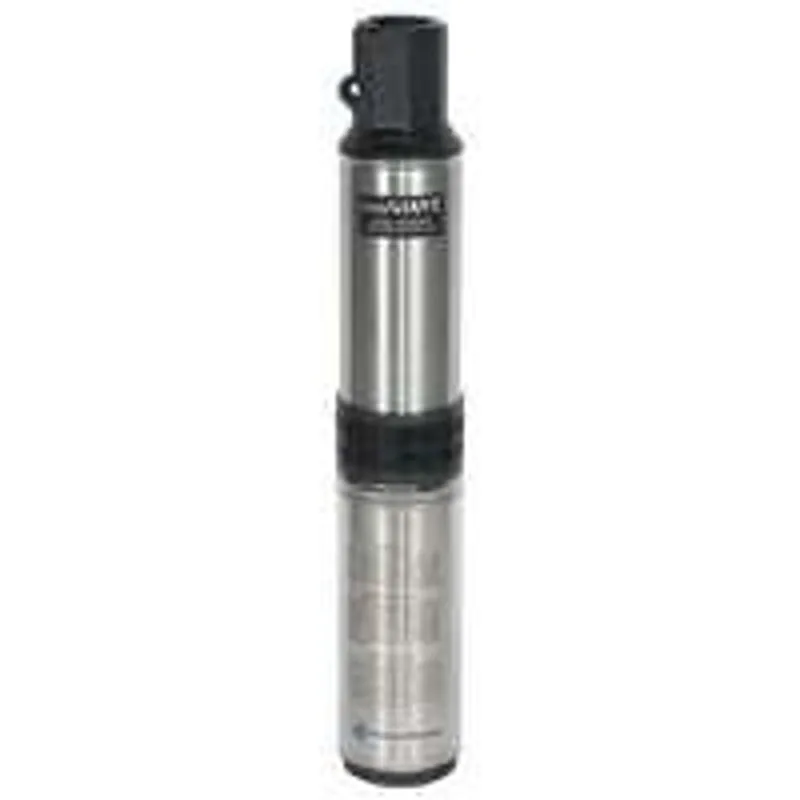
Red Lion RL12G07-2W2V 2-Wire Submersible Well Pump
3/4 hp 2-wire submersible with its starting parts built into the motor.

Flotec FP2211 115 V Deep Well Submersible Pump
Flotec 1/2 hp 2-wire 4-inch submersible that needs no control box.

Flotec FP2222 3/4 HP Deep Well Submersible Pump
3/4 hp 2-wire Flotec model for deeper settings without a box.
Questions readers ask
Does every well pump have a control box?
No. Only 3-wire submersible pumps do. A 2-wire pump has its starting parts inside the motor, and Flotec's wiring for 2-wire models runs straight from the pressure switch to the motor. Jet pumps above ground have their capacitor on the motor itself.
How do I know if my well pump capacitor is bad?
The usual sign is a breaker or overload that trips as the motor tries to start, or a pump that hums but will not run. A swollen or vented capacitor is a giveaway. An electrician can measure it safely after discharging it.
Can I use a Franklin control box with another brand of pump?
Only if it matches the motor, not the pump. Red Lion's installation drawing labels its box as a Franklin control box, but the rule from every maker is that box horsepower and voltage must match the motor nameplate.
Where should a well pump control box be mounted?
Indoors or in a protected spot near the pressure tank, upright, and out of direct sun. Red Lion asks for protection from rain, snow, heat and temperatures below 14 °F; Flotec asks for top side up.